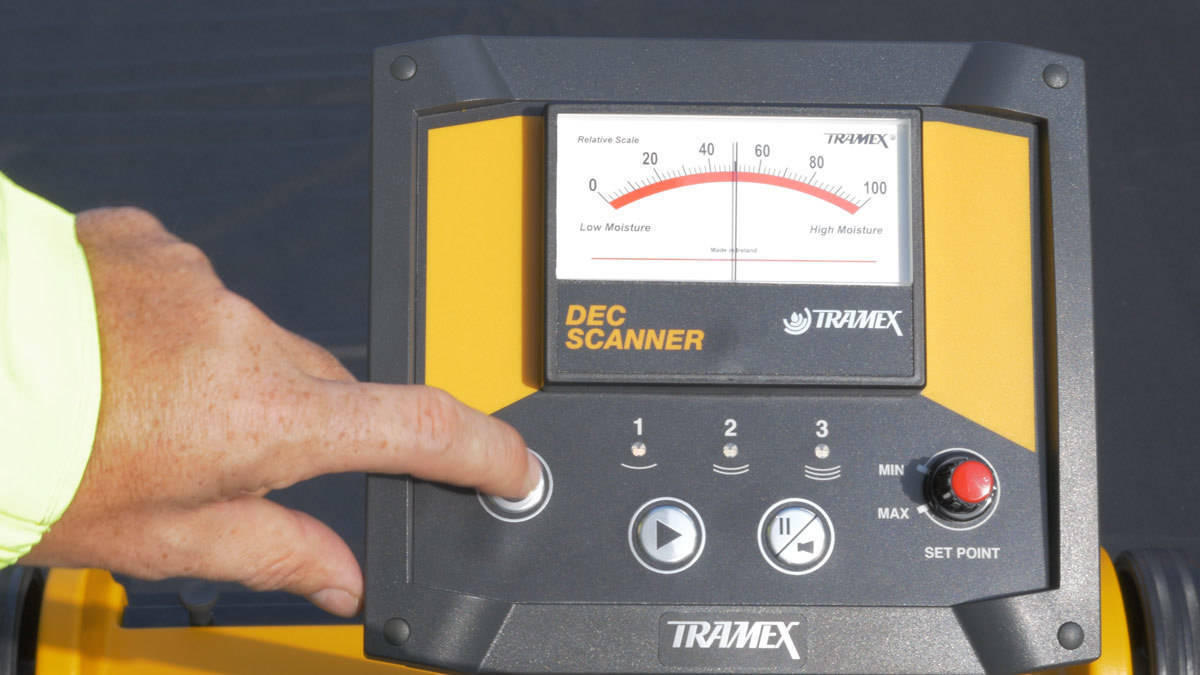
The recover-versus-replace decision on an Omaha commercial roof depends on moisture data, not visual inspection alone. We map insulation saturation before you commit capital — so the scope you fund is the scope the building actually needs.
Visual roof inspections miss moisture. A BUR or modified bitumen surface that looks serviceable from the parapet can be sitting on saturated polyiso that has been wet for two winters. A TPO membrane that appears intact can have wet insulation under every ponding area that formed during the last three storm seasons. The surface tells you about the membrane; it does not tell you about the insulation.
Insulation saturation is the variable that determines whether a recover is viable or replacement is required. Recover a wet insulation assembly and you trap the moisture. Trapped moisture under a new membrane continues to degrade the fastener zone, produces ongoing thermal cycling damage at the bond interface, and voids the new manufacturer warranty. The cost of recovering a roof that should have been replaced is not just the recover cost — it is the recover cost plus an accelerated replacement in three to five years on a system that was never going to perform.
We conduct moisture surveys as a standalone service and as part of pre-replacement and pre-recover assessments. The survey method depends on the building — moisture cores for a direct, definitive result; nuclear scanning for large-area surveys where rapid coverage is the priority; capacitance testing as a supplement to core results on single-ply systems. We map the results to the roof zone diagram and deliver a moisture survey report that drives the recover-versus-replace recommendation.
Moisture Survey Methods We Use
Moisture core pulls: The most direct method — a cylindrical core through the membrane and insulation, extracting a physical sample that we measure with a moisture meter and photograph. Cores are definitive: wet, damp, or dry, with no interpretation required. On most Omaha commercial buildings, we pull five to ten cores in representative locations — more on larger buildings or where ponding staining suggests widespread saturation. Core holes are patched with compatible membrane material and sealant before we leave the roof.
Nuclear moisture gauge scanning: A nuclear gauge (typically a Troxler or equivalent) detects hydrogen atoms in the roof assembly, which correlates to moisture content. The gauge is walked across the roof surface in a grid pattern, and the reading map identifies areas of elevated moisture content. Nuclear scanning covers large areas faster than core pulls and is particularly useful for initial surveys of large single-story industrial buildings where core-pull grid spacing would be impractical. Nuclear scanning identifies suspect areas; we follow up with moisture cores in flagged zones to confirm.
Capacitance testing: An electrical capacitance meter detects moisture by measuring changes in the dielectric constant of the roof assembly. Effective on single-ply membranes over foam or polyiso insulation. Used as a supplement to core data on TPO and EPDM roofs where a broader area scan helps prioritize core locations. Capacitance meters are sensitive to membrane thickness and surface conditions — they are a screening tool, not a definitive result.
Why Moisture Surveys Matter in Omaha's Climate
Nebraska's climate creates two primary insulation saturation mechanisms. The first is freeze-thaw cycling: moisture that enters the assembly through any opening — a failed flashing, a partially blocked drain allowing ponding to build against the perimeter, a cracked pitch pocket — freezes in winter, expands, and opens the entry point wider. Each freeze-thaw cycle drives moisture deeper into the insulation. By the time the surface shows visible failure evidence, the insulation below has often been saturated for two or three winters.
The second mechanism is Missouri River valley humidity. Omaha's summer humidity is significantly higher than the inland Great Plains — the city sits in the Missouri River valley, which drives vapor drive into roof assemblies during the hot, humid summers. Buildings with vapor retarder deficiencies or penetrations through the vapor control layer accumulate moisture from below. This moisture moves upward into the insulation and is often not visible from the surface.
The August 2020 derecho added a third mechanism for dozens of Omaha commercial buildings: membrane displacement or damage during the storm allowed direct water infiltration into the insulation. Buildings inspected immediately post-storm often showed no obvious water intrusion because the membrane had recovered its position after the wind event — but the insulation beneath had taken on water during the event. Post-derecho moisture surveys on those buildings found saturation in areas that visual inspection had cleared.
Moisture Survey Deliverable
The moisture survey deliverable is a written report with three components. First, the survey method documentation: what equipment was used, what grid pattern was followed, how many cores were pulled and at what locations, what the laboratory or field moisture readings were for each core. Second, the zone map: a plan-view diagram of the roof with core locations and nuclear/capacitance scan results overlaid, with wet and dry zones identified. Third, the interpretation: the percentage of the roof area with confirmed or suspected saturation, the severity of saturation by zone, and the recommendation — recover with targeted insulation replacement, full replacement, or no moisture action required.
We present the moisture survey results with the recover-versus-replace recommendation and the reasoning. A roof where 15% of the area reads wet, concentrated at three specific ponding zones that are correctable with drain work, has a very different recover prognosis than a roof where 40% of the area reads wet distributed across the full field. The report makes that distinction explicit.
Frequently asked questions
Do you need to remove membrane to conduct a moisture survey?
For nuclear gauge and capacitance surveys, no — the instrument works through the intact membrane. For moisture core pulls, we core through the membrane and insulation with a cylindrical coring saw. Each core hole is approximately 2-3 inches in diameter and is patched with compatible membrane material and sealant before we leave the roof. The core patches are permanent repairs, not temporary covers.
How many core pulls do you typically perform on an Omaha commercial building?
For a typical 30,000-50,000 sq ft commercial building, five to ten cores in representative locations — distributed across the roof area with concentration at ponding zones, perimeter areas, and any locations with observed surface evidence of prior intrusion. Buildings with suspected widespread saturation or large single-story footprints may require additional cores or a nuclear gauge survey to map the full extent.
How much does a moisture survey cost versus skipping it and just replacing?
On a 50,000 sq ft building where the recover path is viable, a full replacement costs $200,000-$400,000 versus a recover at $100,000-$180,000 — a difference of $100,000 or more. A moisture survey that confirms the recover path is viable costs a fraction of that difference. The survey is not the expensive decision; the wrong capital decision based on no data is the expensive decision.
Can a moisture survey be performed in winter in Omaha?
Nuclear gauge and capacitance surveys are affected by frozen moisture — frozen water registers differently than liquid water, which can produce false readings. Core pulls are definitive regardless of season but require an accessible, snow-cleared roof surface. For Omaha buildings where the timing is critical, we discuss the limitations of winter moisture survey methods and recommend the appropriate protocol for the conditions.
Not sure if your Omaha roof can be recovered or needs full replacement?
We map the moisture before you commit the capital — cores, nuclear scanning, or both, delivered as a written report with a recover-versus-replace recommendation.
Ready to talk through a roof?
Tell us about the building and the roof problem. We'll document it and put a plan in writing — with an honest repair-vs-replace recommendation and no upsell pressure.