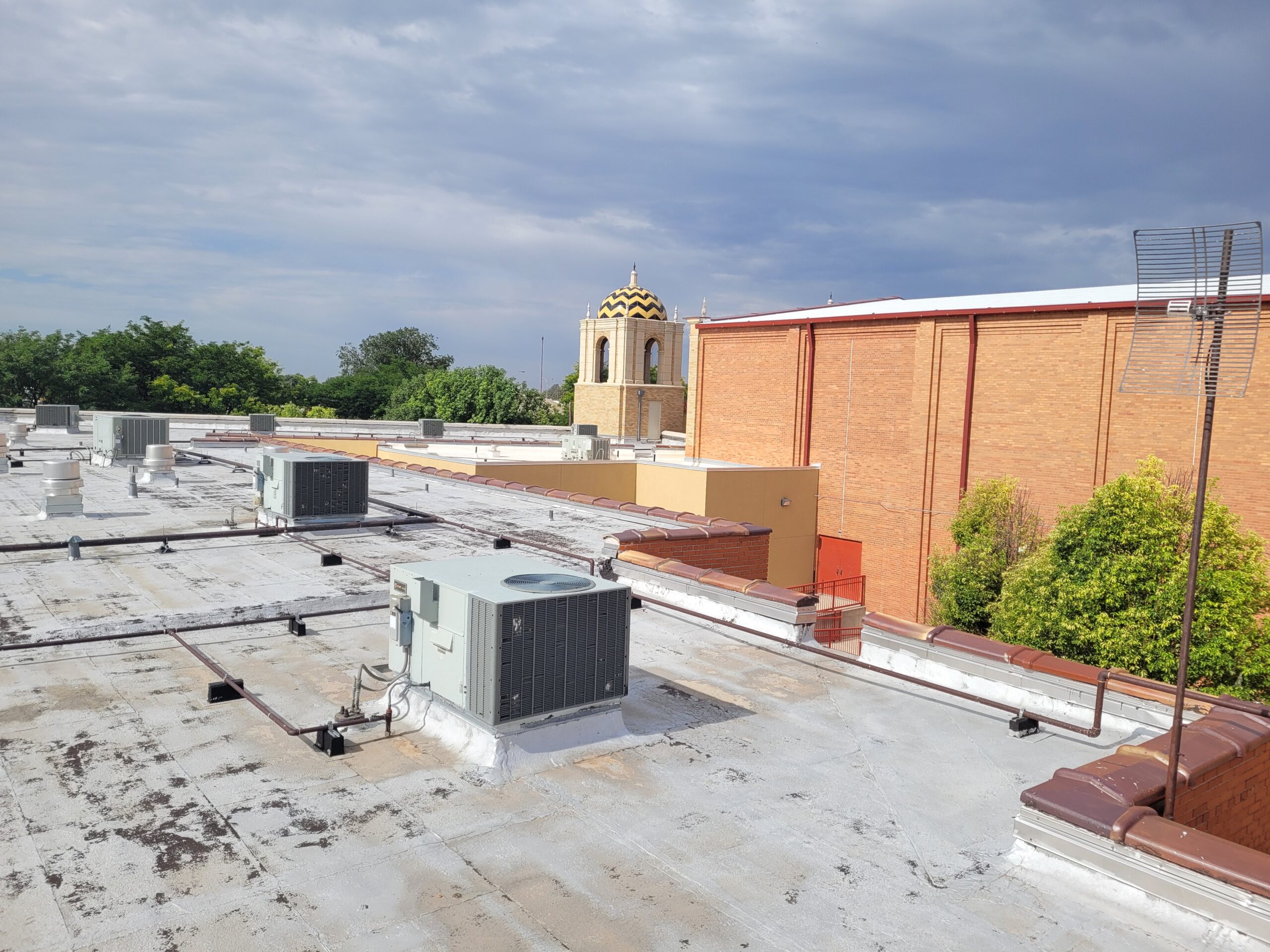
Roof capital spending surprises are a documentation failure, not a weather event. We produce the condition baseline and multi-year forecast that lets Omaha building owners and portfolio managers plan roof capital spending before it becomes emergency capital spending.
The most expensive commercial roof replacement in Omaha is the one that was not in the capital budget. Emergency replacements — driven by a major leak event, an insurance claim, or a building sale that requires a clean condition report — get done on the other side's timeline, not yours. The scope gets compressed, the pricing reflects your urgency, and the sequencing is whatever the market allows, not what the building's operations require. We have seen this pattern often enough that we built our capital planning service specifically to interrupt it.
Capital planning for commercial roofs starts with a documented condition baseline across every building in the portfolio. From the baseline, we assign each building a condition tier and a projected replacement horizon — the year range when replacement or major capital action is expected based on current condition, membrane age, and the Nebraska climate's effect on rate of degradation. We attach an estimated cost band to each future action at current pricing, note any factors that will move the timeline, and deliver the result as a five-year capital forecast the ownership can present to a capital committee or a lender without additional translation.
We work out of, five blocks from the core of Downtown Omaha's commercial district. We inspect and plan for buildings across the full metro — Downtown, the 72nd Street corridor, West Omaha's I-680 buildout, the UNMC and Creighton University campuses, North Omaha industrial, and the Sarpy County suburban fringe. The project manager who builds the capital plan is the same person who runs the inspection and manages the condition file — continuity that keeps the plan connected to the actual building.
Building the Condition Baseline
A capital plan without a documented condition baseline is speculation. We build the baseline by walking every building in the portfolio, documenting existing membrane system and age, drain and flashing condition, ponding patterns, repair history (from building records and from what we can read in the roof itself — repair patches, flashing restarts, blister mapping), and moisture-core results where intrusion is suspected.
Each building gets a condition tier: good (well-maintained system within warranty with no active failures), fair (system performing with identified maintenance items not yet causing failures), poor (active failures or deferred maintenance significant enough to be accelerating system degradation), and end-of-life (replacement within 12-24 months is the correct capital action regardless of other priorities). The tier assignment is based on what we document, not on how old the building owner thinks the roof is.
Roof age and membrane type are inputs, not conclusions. A 15-year-old 60-mil TPO on a well-maintained building with documented annual maintenance, clear drains, and intact flashings may be in better condition than a 10-year-old TPO on a building that has never had documented maintenance and shows active ponding and flashing separations. The condition tier is the output of the inspection, not the arithmetic of age.
Building the Five-Year Capital Forecast
From the condition baseline, we project each building's next major capital action: recover (if cores are dry and the deck is sound), replacement (if cores are wet or the system is genuinely end-of-life), or major maintenance (flashing replacement, drain raise, coating application). Each action gets a projected year range — 'Year 1-2,' 'Year 3-4,' 'Year 5+' — based on condition tier and degradation rate, and an estimated cost band at current Omaha market pricing for that system type and area.
The five-year forecast aggregates those individual building projections into a year-by-year capital schedule: Year 1 capital requirement ($X to $Y, covering Buildings A, B, C), Year 2 ($X to $Y, Buildings D, E), and so on. This is the format that works in a capital committee presentation — it answers the question 'how much roof capital does this portfolio require over the next five years and when?' with documented basis.
We update the forecast after each annual inspection cycle. Condition tiers change — a building that was 'fair' in Year 1 that has been consistently maintained may hold at 'fair' through Year 3; a building that was 'fair' and has had a hard storm season may advance to 'poor' by Year 2. The updated forecast reflects actual condition, not the original estimate.
Capital Planning for Acquisitions and Dispositions
Acquisition due diligence on commercial property in Omaha regularly identifies roof condition as a material item. A roof in poor condition or approaching end-of-life changes the underwriting on an acquisition — it is either a price reduction, a seller credit, or a post-close capital reserve line. We produce acquisition inspection reports that document current condition, assign a condition tier, estimate the capital action and timing, and give the buyer a defensible basis for the conversation.
Disposition due diligence — preparing a building for sale — benefits from the same process run in the other direction. A seller who has a documented inspection report, an active manufacturer warranty file, and a maintenance history on file has a cleaner story than a seller whose roof file is empty. We prepare pre-disposition condition reports that present the roof in its documented condition, which supports the pricing and shortens the buyer's due diligence period.
Frequently asked questions
How far out does the capital forecast go?
Standard capital forecasts are five years. For institutional owners or portfolio managers with longer planning horizons, we can extend the forecast to ten years — though the cost estimates beyond year five carry more uncertainty and are presented as planning ranges rather than project-ready budgets. The five-year range is the horizon where current condition data and Omaha market pricing produce useful accuracy.
How does the forecast handle Omaha's weather variability?
Nebraska's climate creates real variability in degradation rate. A bad hail year or a derecho event can advance a building's replacement timeline by two to three years. The forecast accounts for this by using conservative degradation assumptions and flagging buildings whose condition tier is close to the boundary between 'fair' and 'poor' — these are the buildings most likely to advance faster than the baseline forecast. We note which buildings are close to the tier boundary and recommend inspection frequency adjustments for those.
What does a capital planning engagement typically cost?
Capital planning starts with the baseline inspection across the portfolio. Inspection pricing is based on roof area — typically $0.02 to $0.04 per square foot of roof area for a single-building commercial inspection, with portfolio volume adjustments for multi-building engagements. The capital forecast document is produced from the inspection data and included in the engagement. Ongoing forecast updates are included in the annual maintenance contract.
Can the capital plan be used for lender or insurance presentations?
Yes. We write the capital plan in a format that is readable by lenders, insurers, and institutional investors without requiring translation. The condition baseline, the tier assignments, the projected capital schedule, and the cost estimates are all sourced and explained. We have produced capital planning documents used in commercial mortgage applications, CMBS underwriting packages, and property insurance renewal presentations.
Want a five-year roof capital forecast for your Omaha portfolio?
We start with the inspection, build the condition baseline, and deliver a documented capital schedule — so the next major roof spend shows up in your budget before it shows up as an emergency.
Ready to talk through a roof?
Tell us about the building and the roof problem. We'll document it and put a plan in writing — with an honest repair-vs-replace recommendation and no upsell pressure.