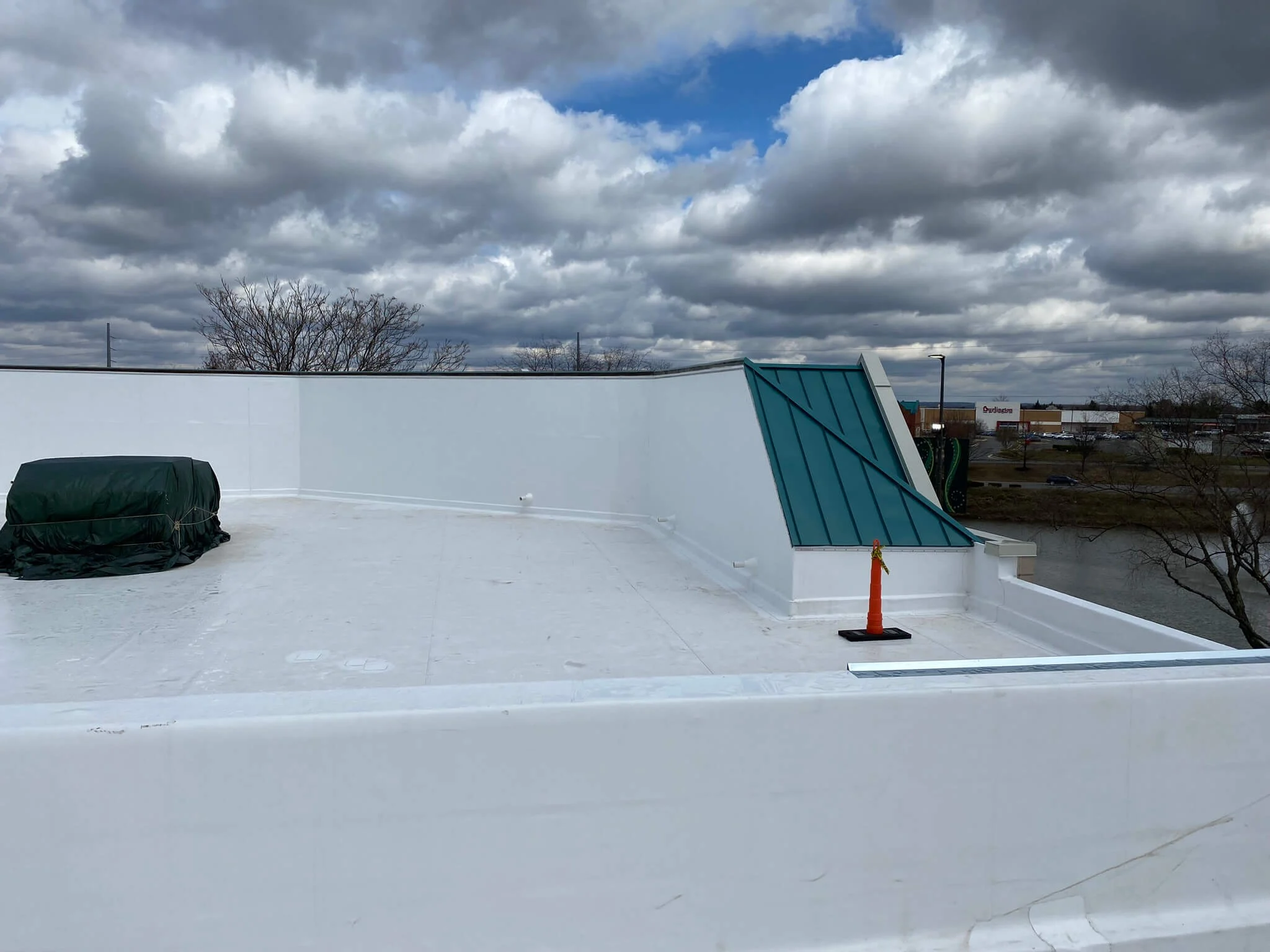
ASHRAE Zone 5A and TPO System Design
Omaha sits in ASHRAE Climate Zone 5A — humid continental, heating-dominated. That designation drives two specific TPO design requirements. First, the insulation stack under the membrane must meet the R-25 minimum for low-slope assemblies under IECC 2021, and most buildings with high heating loads in the Nebraska winter need R-30 or higher to avoid condensation at the deck level. We specify tapered polyiso primary insulation plus a high-density cover board on every TPO replacement project, sized against the building's actual heating load and drain layout.
Second, Zone 5A's freeze-thaw cycling creates thermal movement at parapets that generic flashing details cannot handle. A brick parapet on a Douglas County building cycles between -25°F in January and 100°F on a July afternoon. That is a 125°F swing that moves the parapet measurably — more than a standard EPDM flashing termination can accommodate without cracking at the coping or opening at the base. We specify high-elongation TPO flashing membrane at every parapet and use mechanically-fastened termination bars rated for the full thermal range.
Mechanically attached TPO is the standard system for most Omaha commercial buildings — it handles the metro's wind-uplift requirements and the thermal cycling at the lowest installed cost per square. Fully adhered systems are specified where wind-uplift limits exceed what mechanical attachment can deliver, particularly on West Omaha sites with open I-680 corridor Exposure C conditions. Ballasted systems are rarely appropriate here — snow loading on top of ballast creates concentrated dead load that most Nebraska buildings were not designed for.
Derecho Wind-Uplift and Fastener Pattern
The August 10, 2020 Midwest derecho crossed eastern Nebraska at sustained straight-line winds above 100 mph, with peak gusts recorded above 110 mph at Eppley Airfield. We documented membrane blow-off on more than a dozen Omaha commercial buildings in the weeks following that event. In every case where the system failed, the fastener pattern had been designed for Exposure B conditions on a building that actually sat in Exposure C — open suburban character, no adjacent structures to break the wind field, full derecho exposure.
We run the FM Global or ASCE 7-22 wind-uplift calculation from actual exposure conditions for every TPO project we scope. The field zone, perimeter zone, and corner zone fastener densities are specified separately. A building at the north end of the Eppley industrial corridor has a different corner-zone fastener requirement than a building in the sheltered Midtown Crossing block. We document the exposure category determination in writing so the building owner has a record that survives the next insurance claim.
For existing mechanically attached TPO systems installed before 2015, we check fastener density during inspection by probing at the seam lines and counting plates per linear foot. Undersized patterns are common in the West Omaha and north industrial zones. We document the deficiency and include a fastener supplementation scope in the condition report — lower cost than replacing a blown section after the next derecho.
Seam Quality and the Freeze-Thaw Test
Nebraska's freeze-thaw cycling is the most consistent quality test a TPO seam faces. Omaha sees 50-70 freeze-thaw events in a typical winter — temperatures cycling through 32°F repeatedly from November through March. A seam that was marginally welded at installation, with insufficient overlap, incorrect temperature, or inadequate roller pressure, will open within two to three winters. We see these failures on roofs that passed a cursory visual inspection at closeout but never had a probe test run on every linear foot of seam.
Our weld operators are factory-trained. We test every seam with a 5-pound test wheel during installation, and we probe-test every linear foot before closeout. The test results are documented in the closeout package — not to satisfy a form requirement, but because a building owner on a maintenance contract with us needs to know that the seams we put in will not be the source of a leak call in the third winter after replacement.
We also specify walkway pads on every rooftop traffic path identified during the pre-installation walk. This matters more in Omaha than in markets without HVAC-service traffic in winter — ice buildup on a TPO membrane is a puncture risk every time a maintenance tech crosses the roof in January. Pads eliminate that risk and are part of every TPO closeout package we deliver.
Frequently asked questions
What TPO thickness do you recommend for Omaha commercial buildings?
60-mil TPO for most warehouse, office, and retail buildings with standard maintenance traffic — it handles Omaha's freeze-thaw cycling, carries a 20-year NDL warranty, and is the right cost-per-year choice for most owners. 80-mil for buildings with heavy rooftop equipment, constant maintenance foot traffic like the UNMC campus, or owners who want the 25-year warranty path and lower 30-year lifecycle cost. We do not install 45-mil — the pre-2010 generation is not adequate for Nebraska hail and freeze-thaw conditions.
Can TPO be recovered over existing modified bitumen?
Yes, if the existing assembly passes a moisture-core inspection. We pull cores in five to ten representative locations and at every area of visible ponding or prior repair. If more than 25% of cores read wet, recovering traps that moisture and voids the new manufacturer warranty — replacement is the honest scope in that case. If the assembly is dry and the deck is sound, a TPO recover on new insulation is a viable 20-year path at roughly half the capital cost of full replacement.
How do you handle the derecho insurance documentation for a TPO blow-off?
We provide photo-keyed zone diagrams that distinguish pre-existing installation defects (undersized fastener pattern, marginal seams) from event-related damage. That distinction matters for insurance adjustment — a blow-off caused by an undersized fastener pattern is a pre-existing defect, not a covered storm loss. We document both and provide the written scope that lets the building owner's adjuster or attorney work from defensible facts. We do not represent insureds or promise coverage outcomes.
Scoping a TPO project for an Omaha building?
We will walk the roof, pull moisture cores if the recover-vs-replace decision depends on it, run the wind-uplift calculation from actual exposure conditions, and deliver a written TPO scope with manufacturer warranty path and installed-cost band.
Ready to talk through a roof?
Tell us about the building and the roof problem. We'll document it and put a plan in writing — with an honest repair-vs-replace recommendation and no upsell pressure.