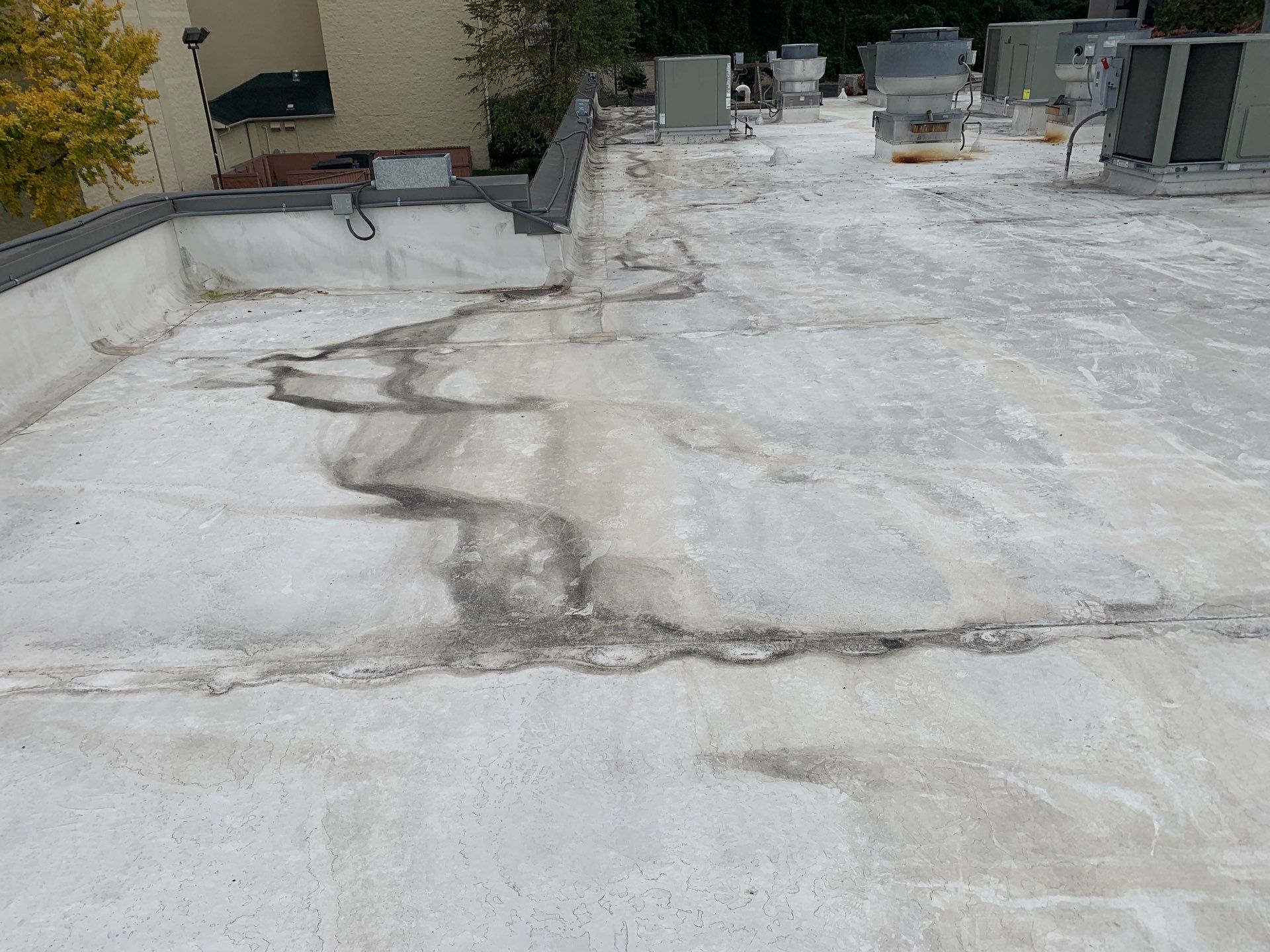
Omaha's location on the open Great Plains means commercial roofs here face wind exposure that buildings in sheltered urban cores elsewhere do not. Persistent westerly winds, spring convective storms, and periodic severe wind events create ongoing stress on membrane attachments, coping caps, and perimeter flashings across every commercial building in the metro.
Wind damage to commercial roofs in Omaha operates on two timescales. Acute damage — from the August 2020 derecho, from tornado outbreaks, from the severe convective storms that move through Douglas County most springs — is visible and immediate: membrane sections lifted, coping caps displaced, equipment curbs shifted. Cumulative wind damage is less visible but more pervasive: persistent westerly winds and seasonal freeze-thaw cycling work the edges of mechanically attached membranes, lift perimeter flashings incrementally, and gradually open the seams that were marginally welded at installation.
We see cumulative wind damage on roofs that passed their last insurance inspection without a claim. The membrane is intact in the field, the seams are holding, but the perimeter termination is lifting at the southwest corner — the upwind face in a metro where prevailing winds come from the northwest and west. That lifting corner is where the next major wind event initiates a larger blow-off. Catching it at the annual maintenance visit is a $400 repair. Missing it until the blow-off happens is a $40,000 insurance claim.
Our inspection protocol for wind damage covers both acute event damage and cumulative perimeter degradation — because in practice, most wind damage claims involve both.
Where Wind Damage Starts on Omaha Commercial Roofs
The perimeter and corners: IBC wind uplift tables assign the highest design pressure to the building corners and the perimeter zone. These are the zones where fastener density should be highest — and where installation shortcuts most often appear. A field-zone fastener pattern applied to a corner zone because the installer ran out of time or material is the single most common wind-damage root cause we document. We find this pattern on buildings across the metro — not just on the oldest inventory, but on buildings installed in the last decade.
Coping cap leading edge: The metal coping cap on a commercial parapet is the building's first line of defense against water infiltrating the parapet cavity. Wind gets under the leading edge of the coping at the upwind face and begins a lifting cycle. The cap cleat deforms, the sealant at the end joints opens, and eventually the cap displaces enough to allow direct water entry into the parapet. We have seen this failure mode on buildings throughout the Aksarben and 72nd Street corridor — the parapet leak shows up as a stain on the interior ceiling six to twelve months after the coping cap first starts lifting.
Flashing termination at walls: Where roof membrane terminates at a vertical wall — at a parapet base, at a mechanical room wall, at an elevator penthouse — the membrane is typically counter-flashed with a separate flashing piece that is sealed and fastened to the vertical face. Wind pressure on the vertical surface eventually opens the sealant joint at the top of the counter flashing. This failure shows up as streaking on interior walls below the roof line after wind-driven rain events.
High-Exposure Zones in the Omaha Metro
Eppley Airfield and the Missouri River bottom: The lowest-elevation terrain in the metro, with no upwind obstructions from the west or northwest. Buildings in this zone are in Exposure C under IBC wind tables — the highest open-terrain classification. Distribution buildings near Eppley, industrial buildings along Abbott Drive, and warehouse buildings in the North 30th Street corridor are all in this exposure zone. Wind damage in this zone is more frequent and more severe than elsewhere in the metro.
West Omaha I-680 corridor: The western suburban ring has limited wind sheltering from adjacent structures. Corporate campuses along the West Dodge corridor at 120th-168th Street are in open suburban terrain with Exposure B or Exposure C conditions depending on the specific site. Werner Enterprises' headquarters and surrounding business parks are in this zone.
Downtown Omaha on windward faces: Even sheltered urban buildings have windward faces that see higher pressure. The west and northwest faces of Downtown high-rise commercial buildings — particularly along Farnam and Harney Streets west of 10th — see the prevailing westerly wind directly. Low-rise commercial buildings adjacent to these towers can receive accelerated wind from the building geometry.
Repair Sequence for Wind Damage
Assess before repairing: We do not approve permanent repair scopes until we have walked the entire roof perimeter and pulled sample fasteners in the damaged zones. A coping cap that blew off may be the visible symptom of a perimeter membrane that has been lifting for two or three seasons. Replacing only the coping cap without addressing the membrane perimeter leaves the building one wind event away from a larger claim.
Coping cap work: Displaced or bent coping caps are removed, end joints re-cut if damaged, new cleats installed at code spacing, and the cap re-set with sealed end laps and continuous sealant at wall joints. We do not attempt to hammer bent caps back into position — deformed metal coping is replaced because its geometry no longer sheds water correctly.
Membrane perimeter repair: Lifted perimeter membrane is mechanically re-fastened at the exposure-appropriate fastener density, not the original (potentially undersized) pattern. Where membrane at the perimeter is torn, we cut back to undamaged membrane and weld a new section with properly lapped seams. Where the existing membrane is within two years of its design life, we recommend replacing the full perimeter zone — partial perimeter repairs on aging membrane often fail at the patches within the next season.
Frequently asked questions
How do I know if my Omaha commercial roof has wind damage after a storm?
Interior ceiling stains that appear within 24-48 hours of a wind event are the most reliable indicator. Visible coping cap displacement or membrane lifting at roof edges is visible from grade on many buildings. We recommend a post-storm roof walk after any event that produced sustained winds above 60 mph in the metro — that threshold is generally where perimeter fastener patterns begin to be tested.
Does wind damage show up on insurance claims differently than hail damage?
Yes. Hail damage is assessed by impact count and density — adjusters look for dents, fractures, and granule loss at the membrane surface. Wind damage is assessed by failure mode — lifted membrane, displaced hardware, torn flashings. We write wind damage inspection reports differently than hail reports, and we flag when the visible damage is ambiguous between the two causes so the adjuster can make the appropriate determination.
My roof held up during the 2020 derecho — does that mean it will hold in future wind events?
Not necessarily. The 2020 derecho tested fastener patterns against peak gusts. Some roofs that held then have since had perimeter lifting develop as seasonal wind cycling and freeze-thaw cycling have opened the membrane edge. A roof that survived the derecho with no visible blow-off can still have a perimeter condition that needs attention. Annual inspection catches this before it becomes a claim.
Omaha wind damage inspection and repair scope?
We walk the full perimeter, pull fastener tests in damaged zones, and produce a written repair scope — not a verbal estimate — within 48 hours of the inspection.
Ready to talk through a roof?
Tell us about the building and the roof problem. We'll document it and put a plan in writing — with an honest repair-vs-replace recommendation and no upsell pressure.