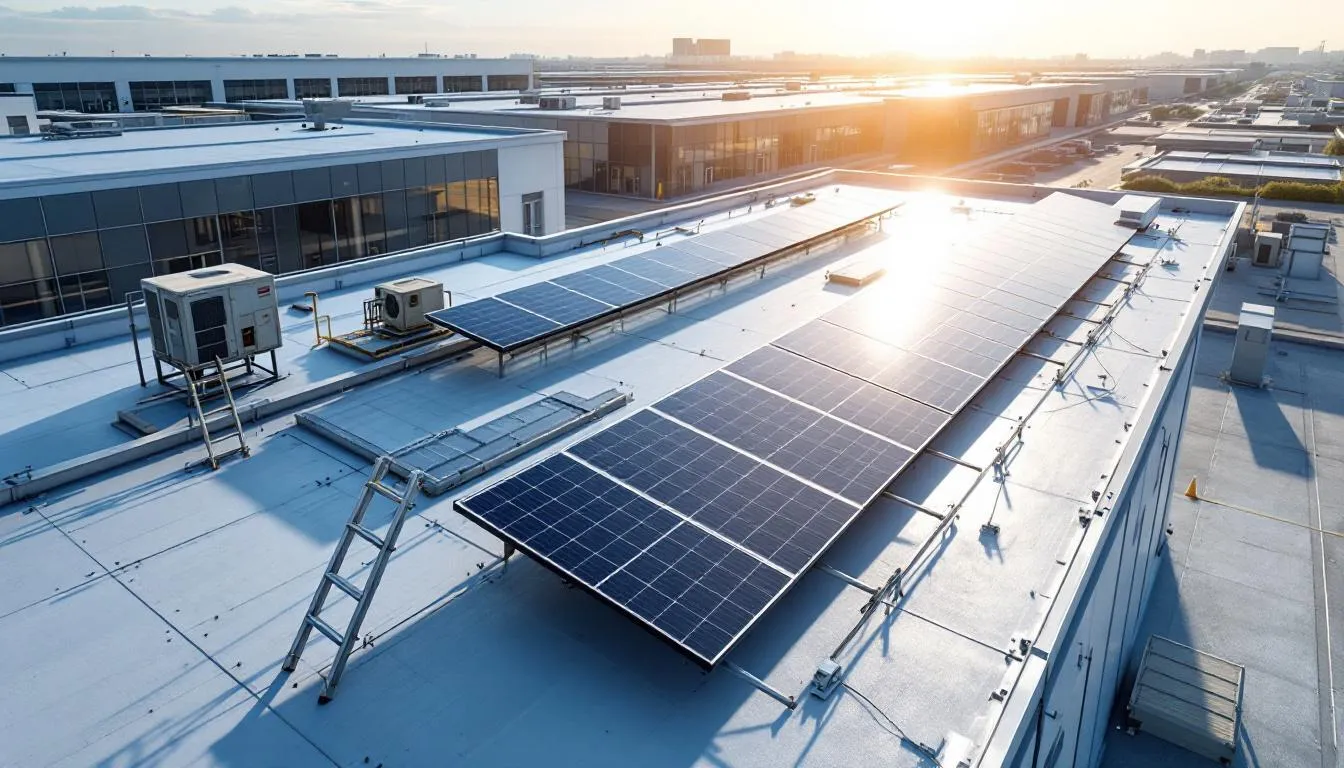
A flex building rarely keeps one identity for long. The same low-slope shell that houses a wholesale distributor on a five-year lease becomes a contractor's shop, a small fabricator, and a back-office showroom as bays turn over. We roof these multi-tenant buildings across the corridors where they cluster in Omaha — the warehouse rows off 108th and J Street, the light-industrial belt near Eppley Airfield and Abbott Drive, the J.E. George and Ralston business parks, and the newer flex inventory pushing south into Sarpy County around Highway in Papillion and La Vista. Every one of those buildings carries a roof that has to absorb constant change without leaking on whoever moves in next.
What sets flex roofing apart from single-user industrial work is the density of penetrations and how few of them are documented. Each tenant build-out adds something: a rooftop condensing unit for a new server closet, an exhaust fan over a paint booth, a fresh conduit run punched through the deck for a tenant's three-phase service. Over fifteen years a 40,000-square-foot flex roof can accumulate dozens of these, half of them flashed by whoever was cheapest that month. Before we price any reroof or recover, we walk the entire roof and build a penetration map — photographing every curb, pipe boot, conduit stand, and abandoned opening, then matching it against whatever original drawings the owner still has. The abandoned penetrations are usually the leakers, because a removed unit gets a sheet-metal cap that nobody ever made watertight.
How Omaha flex buildings are actually built
The stock here spans roughly three eras, and each one drives a different roof scope. The older tilt-up and block buildings from the 1970s and early 80s usually carry aged built-up or gravel-surfaced roofs near the end of their service life, often over wet insulation that has to come off. The 1990s and 2000s flex parks tend to have first-generation single-ply — ballasted EPDM or early mechanically attached membrane — that is now brittle at the seams. The newest pre-engineered metal buildings carry standing-seam or screw-down panels where the question is recover-versus-replace rather than tear-off.
For the masonry and tilt-up buildings, our default is a 60-mil mechanically attached TPO over new polyiso, with tapered insulation worked in at the drains and crickets to pull standing water off a deck that was originally laid dead flat. On buildings where multiple tenants send HVAC techs across the roof constantly, we step up to 80-mil membrane or add reinforced walkway pads on the service routes, because the most common puncture on a flex roof comes from a service boot, not the weather. On the metal buildings we evaluate the panels honestly: if the seams and fasteners are sound, a silicone restoration or a retrofit framing system over the existing panels saves the owner a teardown; if the panels are corroded at the laps, we say so.
Tenant turnover is the real roofing problem
Vacancy is where flex roofs quietly fail. When a tenant pulls out and their rooftop unit comes down, the curb opening gets a temporary cap that is supposed to last until the next tenant — and routinely doesn't survive two Nebraska thunderstorms. Meanwhile nobody is inside the empty bay to notice the ceiling staining. We tell every owner and property manager the same thing: an empty bay needs its roof checked more often, not less. During lease transitions we confirm that every removed-unit curb is properly closed or fitted with a real membrane cap, verify that previous tenant penetrations are sealed to the system, and clear the internal drains and scuppers that fill with debris faster over a vacant suite than an occupied one.
Coordinating work across a building full of tenants
Reroofing an occupied flex building is a logistics exercise as much as a roofing one. We start from a bay-by-bay occupancy map and a single point of contact in property management. That tells us which suites have live rooftop equipment we cannot shut down without notice, which bays are empty and can stage material or tie-offs, and which tenants run noise-sensitive or precision operations that need the loud work scheduled around them. Tenants hear about the schedule through the property manager, and we confirm each section watertight in writing at the end of every workday before the crew leaves — an open tear-off over an occupied bay overnight is not something we leave to the forecast.
What owners and investors get on paper
Most of our flex work is for owners and asset managers holding the building as an income property, so the documentation has to serve a capital plan, not just close out a job. We deliver a condition report with the penetration map, core-sample results where we cut them, photographs of every completed detail, the manufacturer warranty registration, and a roof-zone diagram for the property file. Investors carrying several flex assets get those reports in a consistent format so the whole portfolio can be budgeted off one standard rather than five different inspection styles.
Industrial Flex Space Roofing Questions
Flex roofs accumulate undocumented openings from years of tenant build-outs, and the abandoned ones — where a rooftop unit was removed and never properly capped — are usually the active leaks. We photograph and map every curb, boot, conduit, and closed opening, then compare it to any original drawings before pricing, so the scope reflects the roof that actually exists rather than the one on the plans.
A 60-mil mechanically attached TPO over tapered polyiso handles most tilt-up and block flex buildings in Omaha at a reasonable cost. Where several tenants send HVAC crews across the roof regularly, we move to 80-mil membrane or add walkway pads on the traffic routes, since service-tech foot traffic punctures these roofs more often than hail does.
We work from an occupancy map and a single property-management contact, sequence the loud tear-off around noise-sensitive suites, avoid shutting down live rooftop equipment without notice, and confirm each section watertight in writing before leaving each day. Tenants are notified through the property manager rather than coordinating directly with the crew.
Yes, and it is worth doing. When a unit is removed we install a proper membrane cap rather than a temporary sheet-metal cover, seal the old tenant penetrations into the system, and keep the drains clear — then recommend more frequent inspection over empty suites, since a leak above an unoccupied bay can run for weeks before anyone walks in and sees it.
Yes. On standing-seam and screw-down panel buildings we evaluate the seams, fasteners, and panel corrosion honestly. Where the panels are sound, a silicone restoration or a retrofit framing system over the existing roof avoids a full teardown; where the laps are corroding, we recommend replacement rather than coating over a failing substrate.
Ready to talk through a roof?
Tell us about the building and the roof problem. We'll document it and put a plan in writing — with an honest repair-vs-replace recommendation and no upsell pressure.