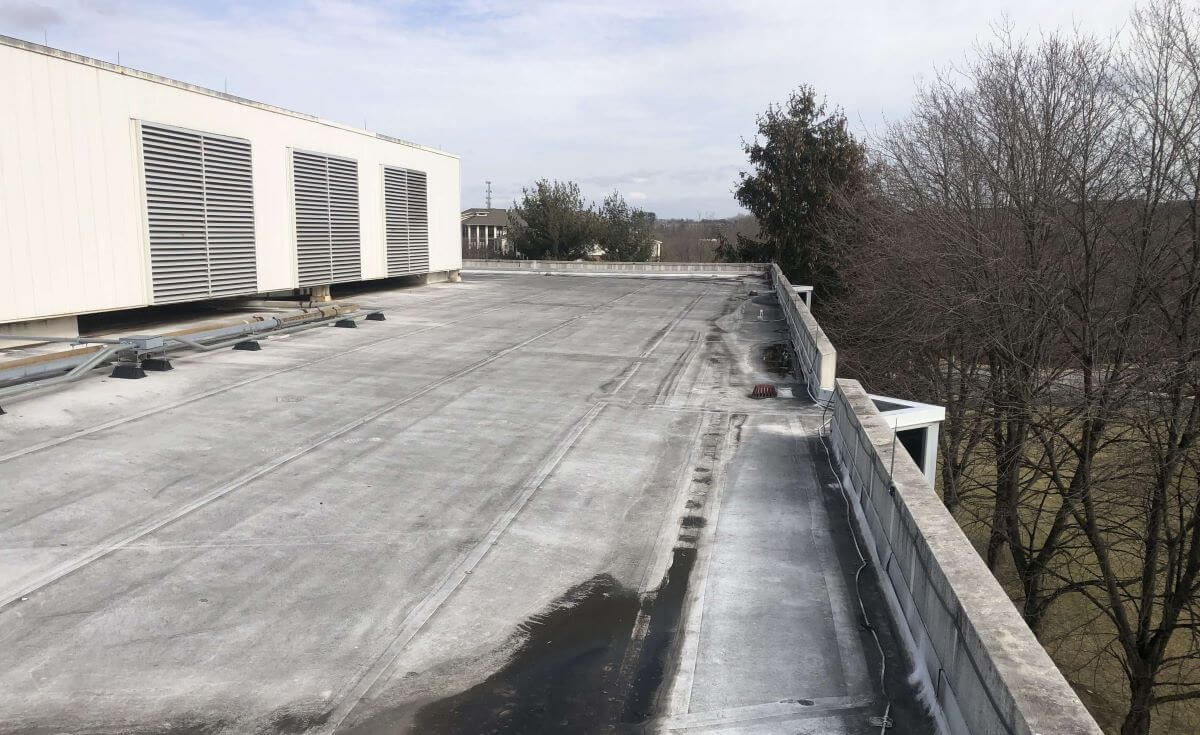
Recover is the right scope when the existing roof's deck and insulation are sound but the membrane has reached end of life. New membrane over existing substrate — no tear-off, lower installed cost, and a fresh manufacturer warranty period when the substrate qualifies.
A roof recover installs a new membrane over an existing roofing system without tearing off the old one. The existing membrane stays in place as the substrate for the new system — the new membrane is mechanically fastened or adhered over it, the existing flashings are stripped and replaced, and the project closes out with a manufacturer warranty on the new system. When the existing insulation is dry and the deck is sound, recover delivers most of the benefit of full replacement at roughly half the cost and without the disposal, disruption, and labor of a full tear-off.
The word that qualifies everything in that sentence is 'when.' Recover over wet insulation traps moisture, accelerates insulation degradation, creates conditions for biological growth in the assembly, and voids the new manufacturer warranty. Recover over a deteriorated deck creates an installation defect that the new membrane cannot compensate for. We do not propose recover until we have the moisture core data and deck condition assessment to know whether the substrate qualifies. That discipline is what separates a recover that runs 20 years from one that fails in five.
Omaha's commercial flat roof stock is heavily weighted toward buildings that are candidates for recover: 1990s and 2000s construction on original TPO and EPDM that is now 20-25 years into service life, with sound insulation and deck but membranes that have cycled through their original manufacturer warranty. We see this on the West Dodge Road corporate corridor, in the Aksarben mixed-use district, and across the Sarpy County suburban buildout. Many of these buildings can recover rather than replace — owners who know this have a significant capital cost advantage over those who assume replacement is the only option.
Moisture Verification — The Non-Negotiable First Step
Before any recover scope is written, we pull moisture cores in a grid across the roof — minimum five cores per 10,000 sq ft, additional cores at any location with visible surface damage, ridging, blistering, or ponding patterns. Cores are pulled with a coring tool and inspected visually and by hand for saturation. On suspect areas, we use nuclear moisture scanning or capacitance moisture meters to map saturation without pulling cores at every location.
Our threshold is 25% wet: if more than 25% of the roof area has saturated insulation, recover is not the right scope. The wet sections would need to be removed and replaced with dry insulation before the recover membrane is installed — and at that point, the cost differential versus full replacement narrows enough that replacement is usually the more economical and structurally honest scope.
When cores confirm dry insulation below 25% saturation, the wet areas are cut out and replaced with dry insulation matching the existing assembly's R-value. The recover membrane is then installed over the repaired field and the original dry insulation. The result is a dry substrate under the new warranty, and a closeout package that documents the moisture verification as evidence of warranty eligibility.
Recover Membrane Options on Omaha Roofs
TPO recover over existing TPO or EPDM: The most common recover configuration in the Omaha metro. New 60-mil or 80-mil TPO mechanically fastened directly through the existing membrane and insulation into the deck. The fastener pattern is designed against the building's wind-uplift requirement — West Omaha and Eppley Airfield corridor buildings in open exposure require denser patterns than sheltered urban-core buildings. Flashing is completely stripped and replaced — recover does not carry over old flashing. New flashing to manufacturer specification is installed on all parapets, penetrations, and curbs.
EPDM recover: 60-mil EPDM over existing BUR or modified bitumen. Common on older industrial buildings on the Missouri River industrial corridor and in North Omaha that have aging BUR systems with dry insulation. EPDM recover is mechanically attached with the same wind-uplift-based fastener pattern discipline as TPO.
Modified bitumen recover: SBS modified bitumen cap sheet over existing BUR. Standard approach for the Downtown Omaha and Midtown commercial building stock with aging built-up roofing. Cold-applied or torch-applied SBS cap sheet over the existing BUR surface after surface preparation and wet-section repair. Carries manufacturer warranties up to 15-20 years depending on the manufacturer and application method.
Insulation recover board: On any recover project, we add a 1/2-inch cover board between the existing membrane and the new membrane — typically high-density polyiso or HD gypsum board. The cover board provides a clean, dimensionally stable substrate for the new membrane, hides minor surface irregularities in the existing membrane, and adds R-value to the assembly. It is a standard line item on our recover scopes, not an optional upgrade.
Code Considerations for Recover in Nebraska
The International Building Code, as adopted in Nebraska, limits buildings to two roofing assemblies — the original installation plus one recover — before tear-off is required. Any building that has already had a recover installed is at its code limit for additional recover layers. We verify this during the pre-scope walk by probing the membrane count at a parapet or penetration edge where multiple layers would be visible in cross-section.
Nebraska energy code (IECC 2021) requires that reroofing projects meet current R-value requirements when more than 50% of the roof area is being replaced or recovered. A standard recover over the existing insulation may fall short of current R-value requirements — we check the existing insulation stack against current code and include a supplemental insulation specification in the recover scope when the as-built assembly is below minimum R-25 for low-slope commercial roofs.
Frequently asked questions
How much cheaper is a recover than a full replacement?
Typically 40-55% less expensive per square foot in installed cost, primarily because tear-off labor and debris disposal are eliminated. The gap narrows when the recover requires extensive wet-insulation replacement. For a 50,000 sq ft Omaha commercial building with dry insulation, the cost difference between recover and replacement is meaningful enough to be a significant capital budget decision.
Does a recover carry a manufacturer warranty?
Yes, when the substrate qualifies. Every major TPO, EPDM, and modified bitumen manufacturer offers warranty coverage on recover installations — the recover membrane and the installation must The warranty term is typically the same as on a new installation: 20 years for 60-mil TPO and EPDM, up to 25 years for 80-mil systems.
What happens to the old roof after a recover?
It stays in place, permanently. The existing membrane becomes a component of the building — an additional layer of waterproofing between the new membrane and the insulation. Buildings on their first roofing assembly can do one recover under code. Buildings that have already recovered cannot do a second recover without tear-off.
Is your Omaha roof a recover candidate?
We will pull moisture cores, assess the deck, and give you a written recover-versus-replace recommendation with cost estimates for both paths — so you can make the capital decision with actual data.
Ready to talk through a roof?
Tell us about the building and the roof problem. We'll document it and put a plan in writing — with an honest repair-vs-replace recommendation and no upsell pressure.