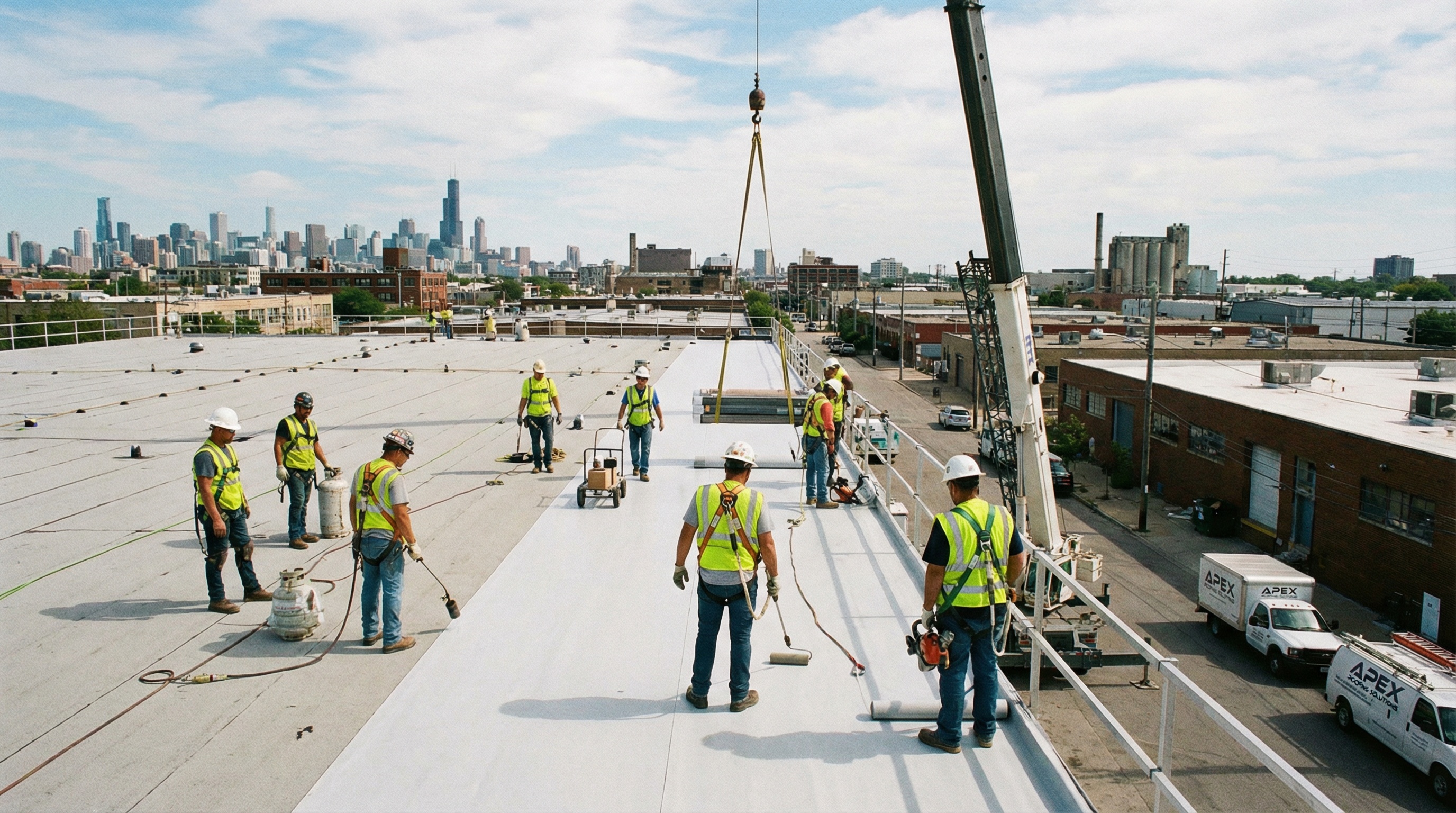
We apply a documented decision framework to the recover-or-replace question on aging Omaha commercial roofs — moisture survey, deck condition, warranty status, and capital horizon — and deliver a written recommendation the owner can take to a capital committee or a lender.
The replacement-versus-recover decision is the highest-stakes choice in commercial roof capital planning. A recover option at 40-50% of full replacement cost is only worth taking if the existing insulation is dry, the deck is sound, and the capital horizon supports the extend-now-replace-later strategy. Recovering wet insulation traps the moisture. Trapped moisture under a new membrane continues to degrade the fastener zone, expands during freeze-thaw cycling, and voids the new manufacturer warranty — turning a $280,000 recover project into a $550,000 emergency replacement three winters later.
Nebraska's freeze-thaw cycle makes this distinction more consequential in Omaha than in warmer climates. Saturated polyiso under a new single-ply membrane in Douglas County will freeze, expand, and fracture the bond interface through 50-70 cycles per winter. The time from a marginal recover decision to a failed roof is shorter here than in markets without that annual freeze load. We apply a structured four-part decision framework to every recover-versus-replace assessment and document the findings so the recommendation can be audited, not just accepted on the contractor's word.
We have recommended recovers on buildings where a full replacement would have generated more project revenue. The recommendation follows the field data. Omaha building owners and asset managers who use our replacement-versus-recover analysis trust the output because it has not consistently pointed toward the higher-value project.
The Four-Part Decision Framework
Part 1 — Moisture distribution: We core the existing roof assembly at a minimum density of one core per 2,000-3,000 sq ft of roof area, with additional cores at all reported leak locations, at drain fields where ponding staining suggests infiltration at the drain perimeter, and at parapet-adjacent zones where freeze-thaw cycling creates flashing failures that allow water entry along the perimeter. Each core is measured with a calibrated moisture meter and photographed. If more than 20-25% of the roof area reads wet, replacement is the correct capital action — recovering wet insulation in Omaha's freeze-thaw climate traps the moisture and accelerates the timeline to failure under the new membrane. If under 20% and the wet zones are concentrated rather than distributed, a selective recover with targeted insulation replacement at the wet areas may be the right scope.
Part 2 — Deck condition: Extended moisture saturation eventually compromises the deck below. On metal deck buildings — the majority of Omaha commercial construction from the 1970s forward — we pull deck inspection ports at wet core locations and at any observable deflection points. Corroded metal deck under wet areas, particularly at drain sumps and parapet-adjacent fields where water channels along the low point, disqualifies the recover path. On the older Downtown Omaha commercial inventory built on wood deck or concrete deck, we check for rot or surface delamination under wet core locations. Deck replacement changes the project scope category and the cost comparison fundamentally.
Part 3 — Warranty status: An active manufacturer warranty on the existing system is a material factor in the recover analysis. Carlisle, Johns Manville, and GAF each have published recover-warranty programs that allow the building to carry a new manufacturer warranty over a recovered system in qualifying condition — in some cases with warranty term credit for the remaining life on the existing warranty. We document the existing warranty number, remaining term, and the manufacturer's stated policy on recover-warranty eligibility for the specific system type and condition.
Part 4 — Capital horizon: A recover extends asset life typically 10-15 years for silicone fluid-applied systems and 15-20 years for single-ply recover systems over existing modified bitumen or BUR. The capital horizon analysis asks: when does the owner plan to sell, refinance, or schedule the next major capital event? A recover that extends life 15 years is the right answer when the capital horizon is 8-10 years. When the horizon is 18 years and a recover would need to be replaced at year 15, a full replacement now may produce lower total capital spend over the planning period. We model both paths explicitly.
Omaha-Specific Factors in the Recover Decision
Freeze-thaw exposure at existing seam laps: On EPDM systems recovered with a new single-ply membrane, the existing EPDM seam laps create a substrate irregularity that can stress the new membrane above the old lap during freeze-thaw cycling. Most manufacturers require that EPDM seam laps be ground or heat-flattened before the recover membrane is applied. We verify seam lap condition across the field during the recover assessment and note whether the existing lap condition is compatible with the specified recover system.
Hail event history and cover board condition: Douglas County is in Nebraska's hail belt. Buildings that have taken one or more documented hail events without a comprehensive hail damage assessment may have cover board compression damage under an otherwise intact membrane surface. Compressed cover board reduces the effective R-value of the insulation stack and affects the wind-uplift fastener performance of a mechanically attached recover system. We pull cores at hail-suspect areas and note cover board condition before finalizing the recover recommendation.
Nebraska energy code applicability at recover: IECC 2021 minimum R-25 for low-slope commercial roofs applies to new construction in Nebraska. The applicability to recover projects — whether adding insulation to City of Omaha, Sarpy County, and Council Bluffs handle this differently. We flag the applicable jurisdiction requirement in the report and confirm it before finalizing the recover scope specification.
What the Written Report Contains
Core log: Core location by zone, layer description from the top membrane through insulation and vapor retarder to deck, moisture meter reading at each layer, and photograph of each core as extracted. The core log is the primary data source for the moisture distribution analysis and the document a manufacturer needs to evaluate recover-warranty eligibility for the specific assembly and condition.
Deck condition summary: Inspection port findings and photographs, keyed to location on the zone diagram. Any conditions that affect the recover recommendation — corrosion, deflection, fastener-zone deterioration — are called out explicitly with photographs and a condition description.
Warranty status documentation: Existing warranty document retrieved from owner records or reconstructed from the manufacturer's warranty desk using building address and approximate installation date. Remaining term, manufacturer's recover-warranty policy for the system type, and any warranty credit available for recover over an in-warranty system.
Recommendation and supporting rationale: A clear, written recommendation — recover or replace — with the specific data points that drive it. Where the data supports a close call, we present both options with the factors that would tip the decision either way and the data sensitivity in each direction. The owner makes the call with full information rather than a contractor's single-path recommendation.
Preliminary cost comparison: Installed cost range for the recover option versus the full replacement option at current Omaha market pricing, plus a reference to our life-cycle cost analysis service if the owner wants the full 30-year NPV model to support the capital decision.
Frequently asked questions
How many cores do you pull on a typical Omaha commercial building?
Minimum density of one core per 2,000-3,000 sq ft of roof area, plus additional cores at every reported leak location, every drain field with ponding evidence, every parapet-adjacent zone in a building with a history of perimeter flashing failures, and any area flagged by a prior infrared scan as a suspected wet zone. On a 100,000 sq ft building, we typically pull 35-55 cores. Every core is logged and photographed and included in the report.
Can we recover if only part of the roof is wet?
Often yes. If wet zones are concentrated rather than distributed — typically under 20-25% of total roof area — a selective recover scope can remove and replace the wet insulation at the identified zones and recover over the confirmed-dry field. This is sometimes called a hybrid recover. We have executed hybrid recover scopes on Omaha commercial buildings where full replacement was not warranted by the data. The selective removal increases recover cost modestly but maintains the economic advantage over full replacement.
Do you recommend a specific manufacturer for the recover system?
No. We specify by performance requirement and present the manufacturer options whose recover systems are eligible for a warranty over the existing assembly type and condition. Which manufacturers will issue a recover warranty over your specific existing membrane, in its current condition, with its existing insulation type, varies by manufacturer. We document which options qualify and present the warranty terms for each.
How long does the replacement-versus-recover assessment take?
Site visit for core pulls, deck port inspection, and zone documentation: one day for a building up to 150,000 sq ft. Written report delivery: five business days from the site visit. If we include an infrared moisture scan as the first phase — which we recommend on buildings with reported leaks distributed across a wide area — add one evening site visit and two to three additional business days to the report timeline.
Facing the recover-or-replace decision on an Omaha commercial building?
We will pull cores, assess deck condition, document warranty status, and deliver a written recommendation with the supporting data — so your capital committee has a defensible basis for the decision.
Ready to talk through a roof?
Tell us about the building and the roof problem. We'll document it and put a plan in writing — with an honest repair-vs-replace recommendation and no upsell pressure.