Omaha's older commercial inventory — Downtown, Midtown, and the pre-1980 industrial stock along the Missouri River corridor — carries a significant BUR inventory. We inspect, repair, recover, and replace built-up roofing systems and give owners an honest account of what the system actually needs.
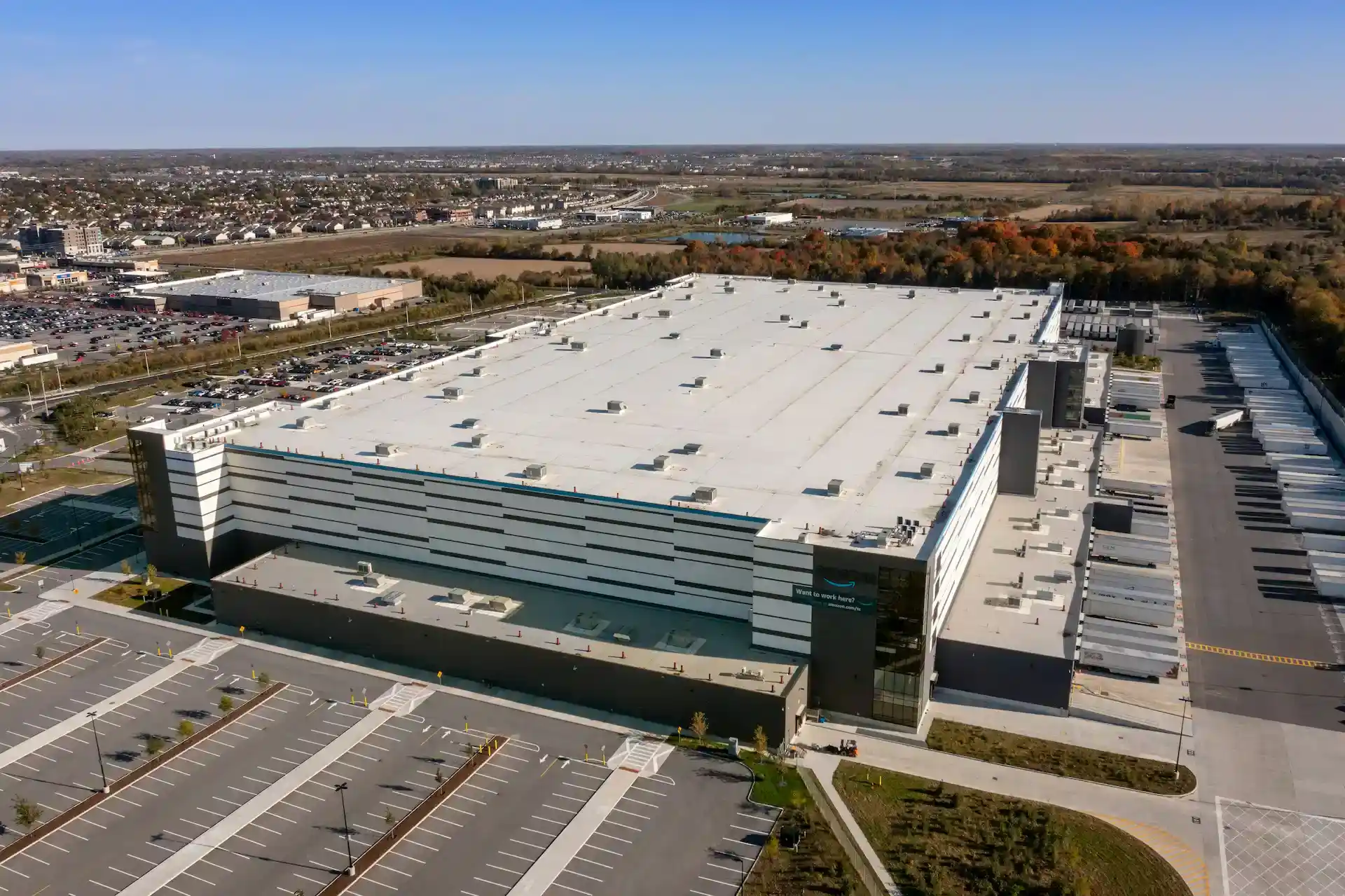
The Union Pacific Railroad intermodal hub at Global One Business Park in Omaha and the ConAgra Foods distribution complex on the north side of the metro represent the anchor facilities of one of the Midwest's most significant logistics corridors. Omaha sits at the intersection of the Missouri River valley's severe weather patterns, which produce some of the most energetic thunderstorms and hailstorms in the country, and the Northern Plains' winter conditions that bring sustained below-zero cold snaps, ice storms, and snow loads that can reach thirty-five pounds per square foot on a large flat warehouse roof. The roofing demands at Omaha distribution centers are among the most complex in the interior United States.
Drainage design for Omaha warehouses must handle both the extreme convective rainfall events of the Great Plains thunderstorm season and the spring snowmelt from Nebraska's significant winter snowpack. The 100-year, one-hour rainfall intensity for Omaha runs approximately five to six inches per hour, and the drainage system must be designed accordingly. Primary interior drains should be sized for a twenty-five-year event, with overflow scuppers positioned two inches above the primary drain rim and sized for the 100-year event. Electric heat cables in the drain bowl and conductor pipe are essential to maintain drainage function during January cold snaps, and the Nebraska State Building Code requires positive slope of at least one-quarter inch per foot to all drains on new commercial roofing assemblies.
EPDM and TPO both have significant market share in Omaha warehouse roofing, and the choice between them depends on project specifics. Fully adhered sixty-mil EPDM performs reliably at Omaha's minus-twenty winter temperatures and is the preferred choice for re-roofing projects on older metal deck buildings. Mechanically fastened sixty-mil TPO is increasingly used on new construction because its heat-welded seams provide superior wind uplift resistance in the severe thunderstorm wind shear events that characterize Omaha's spring and summer weather pattern. Whatever membrane is selected, the insulation specification should include a minimum R-25 above-deck polyisocyanurate system, upgraded to R-30 where the structural capacity allows.
Dock penetrations at Omaha warehouses face the combined stresses of fifty-degree-plus annual temperature swings and the hail-driven debris that impacts dock canopy structures during severe storms. Dock canopy attachment bolts must be flashed with flexible EPDM pitch sleeves capable of accommodating the full range of movement from summer to winter, and the exterior faces of all dock canopy attachment plates should be stainless steel rather than galvanized to resist the corrosive combination of acid rain and road salt that concentrates on Omaha's industrial corridors during winter. Annual inspections of dock flashing details should be timed for September, before the freeze cycle begins, and any sealant joint showing cracking or separation should be cut out and replaced rather than caulked over.
Hail damage is the dominant insurance claim driver for Omaha commercial warehouse roofs. Douglas County is within the North American hail belt, and hailstones exceeding two inches in diameter are documented multiple times per decade in the Omaha metro. Specifying a membrane that meets FM Approval's 1-90 or 1-120 hail impact standard is essential for maintaining commercial property insurance at standard rates. The Omaha insurance market has seen significant premium increases for warehouses carrying membranes without documented hail resistance ratings, and several major carriers have introduced flat exclusions for hail damage on unrated membranes. Sixty-mil reinforced TPO or reinforced EPDM with documented FM hail ratings is the appropriate baseline specification for any large Omaha warehouse.
Wind load design for Omaha warehouses must account for the severe straight-line wind events that accompany the supercell thunderstorms that track through eastern Nebraska from late April through September. Omaha County falls in the 115-mph basic wind speed zone under ASCE 7, and the edge and corner zone fastener calculations for a large, flat warehouse must be performed to that wind speed. The additional design consideration unique to Omaha is the possibility of a microburst — a downburst of wind from a collapsing thunderstorm cell — that can momentarily exceed 100 mph directly over a building for thirty to sixty seconds. Mechanically fastened assemblies with properly calculated perimeter edge fastening are the most reliable approach for resisting these brief but intense wind events.
Energy efficiency at Omaha warehouses is governed by the Nebraska Energy Code, which adopts the IECC and requires R-25 minimum above-deck insulation for commercial buildings in Climate Zone 5. The long, cold Nebraska winter makes heating cost reduction the primary driver of insulation upgrade decisions, and upgrading to R-30 or R-35 above-deck polyisocyanurate provides meaningful heating cost reductions. OPPD (Omaha Public Power District) and MidAmerican Energy both offer commercial efficiency rebates for above-code insulation in commercial re-roofing projects. A white TPO membrane at SRI 80 or higher also contributes to cooling cost reduction during Omaha's hot summer months, and the combination of high insulation and cool membrane maximizes the return on investment over the membrane's service life.
Scheduling an Omaha warehouse re-roof requires working around both the severe weather season and the operational calendar of the distribution tenant. The peak tornado and severe thunderstorm season runs April through June in Nebraska, and large re-roofing projects with extensive exposed deck areas are inadvisable during this period. The best construction window is July through September, when the severe weather risk has diminished and the temperatures are favorable for both adhesive and heat-welded membrane applications. October installations carry early freeze risk, and any work that extends into October requires a daily weather monitoring plan with a two-hour decision window for covering exposed sections.
Choosing a roofing contractor for an Omaha distribution center means verifying their Nebraska contractor license, their experience with FM-approved hail-resistant assemblies, and their supply chain access to the materials required for cold-climate installation. Nebraska requires a separate commercial roofing license from the Contractor and Landscape Architect Licensing Board, and contractors operating without this license expose the property owner to contractor-related liability that standard commercial property insurance may not cover. Request FM Global approval documentation, references from comparable Omaha warehouse projects, and a detailed project schedule that demonstrates awareness of Nebraska's severe weather season constraints.
- What hail resistance is needed for a commercial warehouse roof in Omaha?
- Specify a membrane meeting FM Approval 1-90 or 1-120 hail impact standard. Douglas County is in the North American hail belt with documented multi-inch hail events multiple times per decade. Omaha insurance carriers are increasingly excluding hail damage on unrated membranes, making FM hail documentation essential for maintaining standard coverage.
- What is the best membrane for an Omaha warehouse?
- Mechanically fastened sixty-mil TPO with heat-welded seams and FM hail and wind ratings is the preferred specification for new Omaha warehouse construction. Fully adhered EPDM is equally appropriate for re-roofing projects on older metal deck buildings where mechanical fastening density is limited.
- What energy code applies to warehouse re-roofing in Omaha?
- Nebraska's adopted IECC requires R-25 minimum above-deck insulation for Climate Zone 5 commercial buildings. Upgrading to R-30 qualifies for OPPD and MidAmerican Energy commercial efficiency rebates, with heating cost savings that typically achieve payback within five to seven years.
- When is the best time to schedule a warehouse re-roof in Omaha?
- July through September is the optimal window, after the peak April-June tornado and severe thunderstorm season. October installations carry early freeze risk and require daily weather monitoring. Avoid large exposed-deck phases during the April-June severe weather season to reduce emergency cover requirements.
- What contractor license is required for commercial roofing in Nebraska?
- Nebraska requires a commercial roofing license from the Contractor and Landscape Architect Licensing Board. Unlicensed contractors expose property owners to liability that standard commercial insurance may not cover. Verify license status and request FM Global approval documentation before signing any commercial roofing contract in Omaha.
Frequently asked questions
My BUR roof is 30 years old. Should I recover or replace it?
Age alone does not determine the answer — insulation condition and ply integrity do. A 30-year BUR with dry insulation and intact plies is a strong candidate for modified bitumen cap sheet recover. A 30-year BUR with saturated insulation across large areas needs replacement. We pull moisture cores to give you the actual answer, not the one that sells the most work.
How long does BUR repair typically take on a Downtown Omaha building?
Targeted BUR repair — flashing replacement at parapets and penetrations, blister repair, crack routing and fill — typically runs 2-5 days for a 20,000-30,000 sq ft roof. Full recover with modified bitumen cap sheet runs 1-2 weeks for the same footprint. Access and permitting on Downtown Omaha buildings (crane, lane closure, parking permit) can add pre-mobilization time of 2-3 weeks.
Can you repair a BUR roof in Omaha winter?
Hot-mopped BUR and torch-applied modified bitumen require substrate temperatures above 40°F for proper adhesion. Cold-applied bituminous repair products can be applied at lower temperatures. Emergency temporary repairs — stopping an active leak — can be done with cold-applied materials in any weather. Permanent BUR repair and recover is scheduled for April through October in most years.
BUR inspection or scope for your Omaha building?
We will walk the roof, pull cores where the condition warrants it, and deliver a written condition report with a repair, recover, or replace recommendation — and the reasoning behind it.
Ready to talk through a roof?
Tell us about the building and the roof problem. We'll document it and put a plan in writing — with an honest repair-vs-replace recommendation and no upsell pressure.