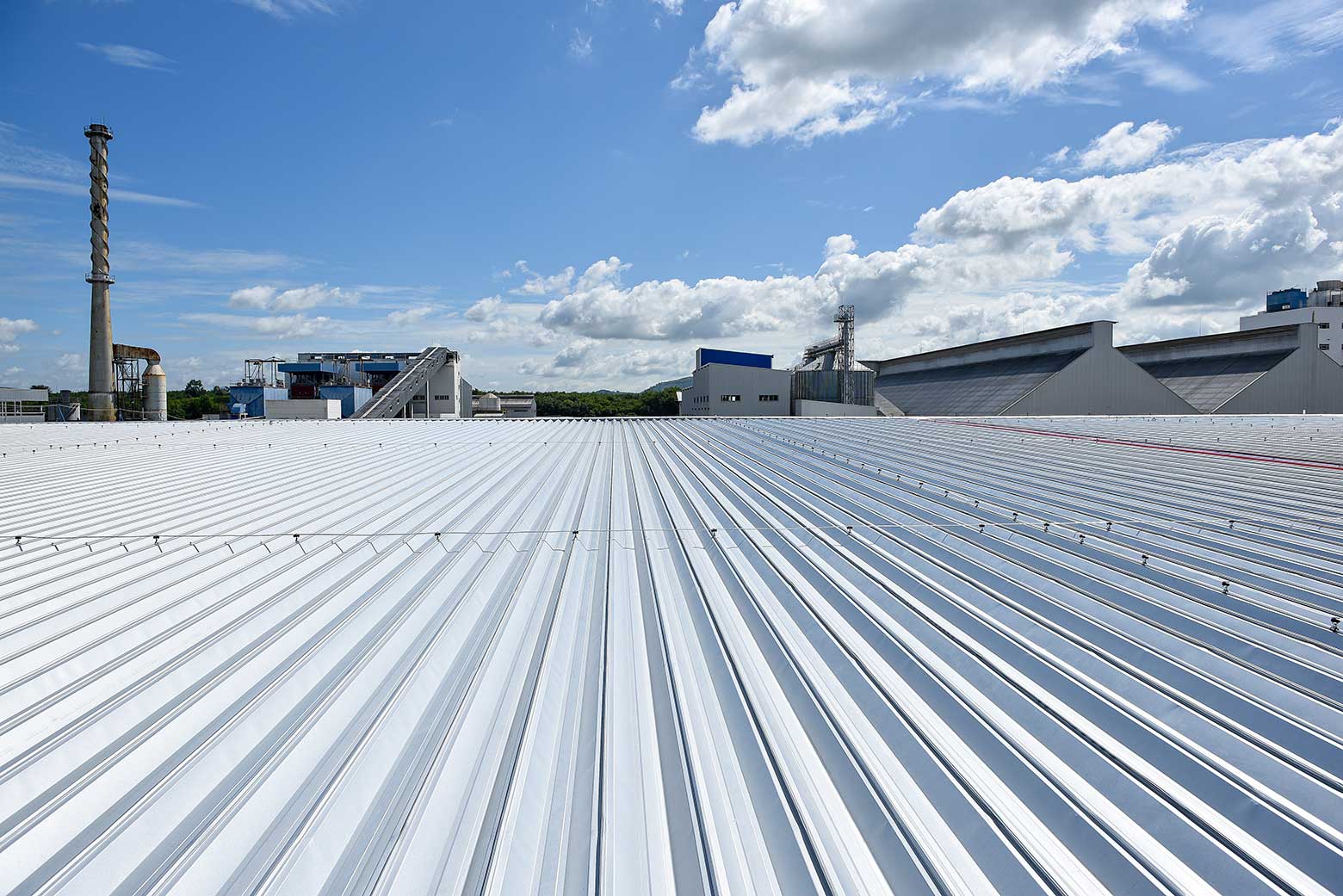
Standing seam metal is the longest-lived commercial roof system available in Nebraska. Concealed fasteners, floating panel geometry, and factory-applied coatings designed for the freeze-thaw cycling, hail exposure, and derecho-grade winds that are routine across the eastern Nebraska climate zone.
Most commercial buildings in Omaha are on low-slope flat roofs — TPO, EPDM, BUR. Standing seam metal is the right call on a different category of building: sloped roofs on industrial and agricultural structures, retrofit over failing low-slope systems where the owner wants a permanent solution without repeated reroof cycles, and new construction where a 40-year roof system with minimal maintenance requirements justifies a higher installed cost. We install standing seam systems in Galvalume steel and aluminum, with panel profiles from 12 to 24 inches, in concealed-clip floating configurations that accommodate the thermal movement Nebraska temperatures demand.
The case for standing seam in Omaha comes down to lifecycle math. A 60-mil TPO system installed today will cost roughly $8-12 per square foot installed. It carries a 20-year warranty and realistically runs 25 years with documented maintenance. A standing seam metal system runs $18-28 per square foot installed and carries 40-year paint warranties and essentially unlimited structural life if details are maintained. On buildings with long ownership horizons — farm bureaus,
We do not push standing seam where it does not fit. It is not the right call on a 200,000 sq ft flat-roof distribution building in the I-680 corridor — the slope geometry does not work and the installed cost differential is not recoverable. Where it does fit — manufacturing plants with pitched roof structures, rural Nebraska agricultural buildings, sloped-roof sections on mixed commercial buildings, and retrofit over failing flat roofs where a structural support system can be installed — we scope it and install it to manufacturer specification with concealed fasteners and the correct panel movement allowance for Omaha's thermal range.
Panel Systems We Install
Structural standing seam: The workhorse for commercial and agricultural applications. Panels span directly between purlins without a continuous substrate — spans up to 5 feet depending on panel gauge and snow load design. Correct for new agricultural buildings, large industrial structures, and retrofit applications where a structural support grid is being installed over an existing failed flat roof. Gauge typically 24 or 26 Ga steel in Galvalume AZ-50 coating or factory-applied Kynar 500 finish.
Architectural standing seam: Panels require a solid substrate. Used on sloped sections of mixed commercial buildings, on covered walkways and canopies attached to larger structures, and on retrofit applications where the existing deck provides the substrate. Typically aluminum for corrosion resistance, 0.032 to 0.040 inch thickness. Panel widths from 12 to 18 inches with seam heights from 1 to 3 inches.
Snap-lock versus mechanically seamed: Snap-lock panels engage without a seaming machine and are faster to install but are rated to lower wind-uplift values. Mechanically seamed panels are folded with a seaming machine, creating a structural seam rated to higher uplift loads — required on buildings in Exposure B or C wind zones, which includes most open-site commercial buildings along the I-680 corridor and in the Eppley Airfield area north of Downtown Omaha.
Why Nebraska's Climate Demands Floating-Clip Systems
Omaha's thermal envelope spans roughly 125 degrees Fahrenheit between extreme winter low (-25°F in January on record years) and peak summer surface temperature (steel panels at full sun exposure in August reaching 150°F or higher). A 30-foot steel panel installed at 70°F will expand and contract more than three-quarters of an inch across that full temperature range. Fixed-fastener systems that penetrate the panel field — through-screw exposed fastener systems — create stress concentrations at each fastener hole that eventually elongate the hole, allow water infiltration, and cause corrosion streaking at every fastener.
Concealed floating clips eliminate this problem. The clip anchors to the substrate; the panel floats over the clip without a fixed connection through the panel face. The panel moves with temperature, the clip holds structure, and there is no penetration in the panel field to elongate or leak. This is not a premium upgrade on Nebraska commercial buildings — it is the baseline correct specification for any building that will be in service for more than 20 years in this climate.
Retrofit Over Existing Flat Roofs
The most cost-effective standing seam application for many Omaha owners is retrofit over an existing failing flat roof rather than tear-off and replacement. A structural support grid — typically hat-channel purlins or a steel sub-framing system — is installed over the existing membrane, creating the slope and structure for the new metal panel system. The existing membrane stays in place as a secondary moisture barrier. The building gets a metal roof without the debris-handling cost of a full tear-off, and the owner gets a 40-year system over the existing structure.
Retrofit works when the existing deck structure can carry the dead load of the support grid and the panel system — typically 3-5 lb per square foot. We pull structural drawings or conduct a dead-load assessment before scoping any retrofit. Buildings with compromised deck structure need deck repair or deck replacement before retrofit framing is installed. Buildings in the Downtown Omaha core with brick parapets require parapet cap detailing specific to the metal panel edge — we specify this in the scope and review it with the manufacturer's technical rep before fabrication.
Frequently asked questions
Does standing seam metal handle Nebraska hail?
Steel standing seam panels at 24 Ga or heavier are highly resistant to the 1-2 inch hail common in Douglas County. The 2-3 inch hail that accompanies the strongest spring supercells can dent lighter gauges and aluminum panels. For buildings in hail-exposed areas — open suburban sites in West Omaha, the Eppley Airfield corridor — we recommend 24 Ga steel as the minimum and review the hail impact classification with the owner and their insurance carrier before specification.
Can standing seam be installed in Nebraska winters?
Steel and aluminum panel installation has no temperature lower limit — there are no adhesives or adhesion-sensitive materials involved. The practical limits are snow and ice on the existing surface during retrofit work, and cold conditions for sealant application at penetrations and panel terminations. We can install structural standing seam on new framing through Nebraska winters with appropriate staging for sealant work.
What does standing seam cost per square foot in Omaha?
Structural standing seam on a straightforward industrial building with clear spans and simple geometry runs $18-24 per square foot installed. Architectural panels on sloped commercial sections, complex geometry, or retrofit over existing roofs with custom framing run $22-30 per square foot. We scope every project individually — the geometry, the panel profile, the finish, and the framing system all affect cost significantly.
Standing seam metal scope for your Omaha building?
We will walk the structure, pull drawings if available, and produce a written scope with panel profile, attachment system, and installed-cost band — not a ballpark.
Ready to talk through a roof?
Tell us about the building and the roof problem. We'll document it and put a plan in writing — with an honest repair-vs-replace recommendation and no upsell pressure.