Omaha's older commercial inventory — Downtown, Midtown, and the pre-1980 industrial stock along the Missouri River corridor — carries a significant BUR inventory. We inspect, repair, recover, and replace built-up roofing systems and give owners an honest account of what the system actually needs.
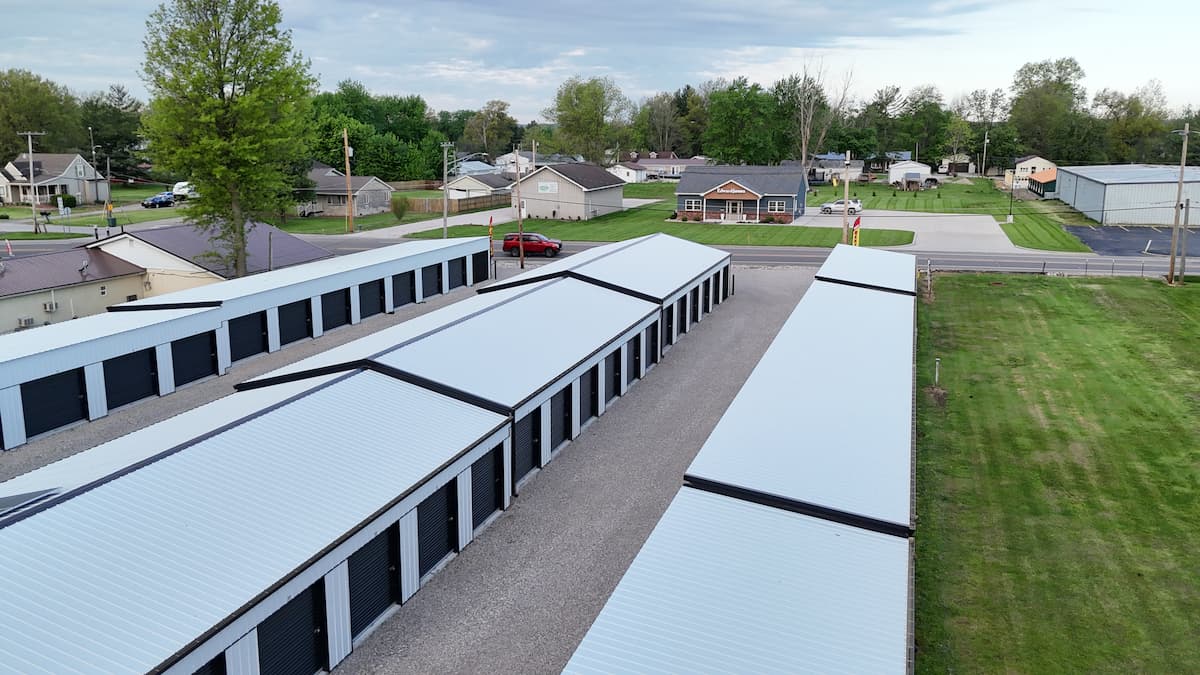
StorageMart on West Dodge Road in Omaha, Nebraska manages one of the anchor self-storage properties in the western Omaha corridor, where the city's consistent growth has driven strong occupancy rates and increasing operator investment in physical plant quality. Omaha's self-storage market faces a classic Great Plains climate challenge: severe hailstorms that rank among the most destructive in the country, winter snow loads that require careful engineering, and a summer severe weather season that brings winds and rain in rapid-onset systems that test roof drainage and attachment at the same time.
Nebraska consistently ranks among the top states for hail frequency and severity, and the Omaha metro is directly in the path of the storm tracks that produce the largest hailstones in the spring and early summer seasons. A self-storage roof in Omaha that was installed without a Class 4 impact-resistant membrane is functionally underspecified for the market. We do not install roof systems on Omaha storage buildings without impact-resistant specification, and we specifically review insurance requirements with each operator before selecting a product to ensure that the specified system meets the insurer's rating requirement for coverage continuity.
Wind uplift from Omaha's severe weather events is a secondary concern to hail but is not trivial. The Missouri River valley and the flat terrain of eastern Nebraska provide minimal wind protection for large storage campuses, and straight-line winds from severe thunderstorm cells regularly exceed 70 mph. Our uplift calculations for Omaha storage use the ASCE 7 design wind speeds for central Nebraska, and we use fully adhered assemblies at all corners and perimeter zones where uplift pressures are highest.
Snow load management in Omaha is straightforward compared to Montana or North Dakota, but it is not negligible. The ground snow load for Omaha is in the 20 to 25 psf range, and drift accumulation at parapets and elevation changes can produce localized loads significantly above the ground snow level. We review the structural framing of every Omaha storage building before re-roofing to confirm that the new assembly weight plus the design snow load is within the structural capacity of the existing deck.
The Omaha market has seen significant growth in climate-controlled self-storage, driven by the region's hot summers and cold winters that make uncontrolled storage problematic for sensitive goods. Climate-controlled buildings in Omaha require roof assemblies that support their thermal performance goals: a properly specified insulation layer reduces both heating and cooling loads, and the payback on premium insulation is measurable in reduced utility costs over the system's life. We size the insulation assembly to meet or exceed ASHRAE 90.1 requirements for the North Central climate zone.
Drainage design for Omaha storage buildings must handle the intense convective rainfall events of the Great Plains storm season. A two-inch-per-hour rainfall rate is not unusual in Omaha during a severe thunderstorm, and a 40,000-square-foot storage campus can generate 50,000 gallons of runoff per hour from that event. We size roof drains and downspouts for the 25-year storm event and install overflow scuppers at all interior roof sections as emergency capacity. Gutters are sized to carry the design flow without surcharging and are pitched at a minimum of one-quarter inch per foot to prevent standing water between rain events.
Tenant protection during an Omaha re-roof requires the same rapid weather response protocol that we use throughout the Great Plains. Severe weather warnings can follow a severe thunderstorm watch by as little as twenty minutes in eastern Nebraska, and our crews maintain the ability to cover any open decking within fifteen minutes of a warning. We brief every crew on the Omaha emergency close-out protocol at the start of each project and conduct a daily weather briefing before opening any roof section.
Nebraska does not have a statewide contractor licensing law for general contractors, but Omaha requires a commercial contractor's registration and building permit for all commercial roofing work. We are registered with the City of Omaha and maintain the insurance and bonding levels required for institutional storage account contracts. Our permit management process includes application, inspection scheduling, and post-completion documentation provided to the facility manager as part of the project closeout package.
Omaha's self-storage market is supported by a diversified economy anchored in insurance, financial services, food processing, and the growing technology sector. The market has seen steady consolidation and increasing institutional ownership over the past decade, and operators who maintain well-documented, properly warranted facilities are attractive acquisition targets in a market where institutional buyers have become active. A properly executed commercial roof is a material component of the physical plant value story in an Omaha storage portfolio.
- What hail resistance is required for an Omaha self-storage roof?
- We specify Class 4 impact-resistant membranes as standard for all Omaha projects. Nebraska's hail frequency and severity make this the only defensible specification, and many Omaha commercial property insurers require it for competitive coverage terms.
- How do you size roof drainage for Omaha's severe storm events?
- We size all drainage systems for the 25-year storm event and install overflow scuppers at all interior roof sections. Gutters are sized to carry the design flow and pitched at minimum one-quarter inch per foot. Interior drain systems are calculated for the peak rainfall intensity observed in eastern Nebraska severe weather.
- What snow load applies to Omaha self-storage roofs?
- Ground snow load for Omaha is approximately 20–25 psf, with drift loads at parapets and elevation changes potentially two to three times higher. We confirm structural capacity before every Omaha re-roof, particularly on older buildings where the original design margins may be narrow.
- How do you manage severe weather during an Omaha re-roof?
- We monitor weather continuously and maintain the ability to cover open decking within fifteen minutes of a severe weather warning. We conduct a daily weather briefing before opening any roof section, and we never open more decking than we can close in that timeframe.
- Are permits required for self-storage roofing in Omaha?
- Yes. Omaha requires a commercial building permit for all re-roofing work. We manage all permit applications, inspections, and post-completion documentation as part of our standard project scope.
Frequently asked questions
My BUR roof is 30 years old. Should I recover or replace it?
Age alone does not determine the answer — insulation condition and ply integrity do. A 30-year BUR with dry insulation and intact plies is a strong candidate for modified bitumen cap sheet recover. A 30-year BUR with saturated insulation across large areas needs replacement. We pull moisture cores to give you the actual answer, not the one that sells the most work.
How long does BUR repair typically take on a Downtown Omaha building?
Targeted BUR repair — flashing replacement at parapets and penetrations, blister repair, crack routing and fill — typically runs 2-5 days for a 20,000-30,000 sq ft roof. Full recover with modified bitumen cap sheet runs 1-2 weeks for the same footprint. Access and permitting on Downtown Omaha buildings (crane, lane closure, parking permit) can add pre-mobilization time of 2-3 weeks.
Can you repair a BUR roof in Omaha winter?
Hot-mopped BUR and torch-applied modified bitumen require substrate temperatures above 40°F for proper adhesion. Cold-applied bituminous repair products can be applied at lower temperatures. Emergency temporary repairs — stopping an active leak — can be done with cold-applied materials in any weather. Permanent BUR repair and recover is scheduled for April through October in most years.
BUR inspection or scope for your Omaha building?
We will walk the roof, pull cores where the condition warrants it, and deliver a written condition report with a repair, recover, or replace recommendation — and the reasoning behind it.
Ready to talk through a roof?
Tell us about the building and the roof problem. We'll document it and put a plan in writing — with an honest repair-vs-replace recommendation and no upsell pressure.