Omaha's older commercial inventory — Downtown, Midtown, and the pre-1980 industrial stock along the Missouri River corridor — carries a significant BUR inventory. We inspect, repair, recover, and replace built-up roofing systems and give owners an honest account of what the system actually needs.
The Union Pacific Railroad headquarters tower at in downtown Omaha and the Mutual of Omaha corporate campus on Dodge Street define the Class A office roofing market in Nebraska's largest city. Omaha's office stock reflects a climate that delivers severe Great Plains thunderstorms, hail events that rival Oklahoma and Texas in frequency and stone size, winter cold snaps that push temperatures to minus fifteen Fahrenheit, and spring flooding potential from the Missouri River that periodically affects the lower-elevation portions of the downtown office corridor. Managing these extremes requires roofing systems that perform across a wider temperature range than most continental US cities demand.
Occupied building protocols at Omaha Class A office buildings are shaped by the corporate standards of anchor tenants like Union Pacific and Mutual of Omaha, both of which maintain formal facilities management programs with documented construction protocol requirements. Mutual of Omaha's campus master maintenance standards specify minimum insurance requirements, construction noise curfews, air quality testing protocols during demolition phases, and post-completion inspection procedures that the roofing contractor must satisfy as a condition of occupancy access. A roofing contractor who has not reviewed these tenant standards before bidding a Mutual of Omaha campus project will encounter scope additions and compliance costs that eliminate any price advantage over a properly informed competitor.
Green roof options are increasingly evaluated for Omaha Class A buildings as part of LEED certification pursuits driven by Union Pacific's corporate sustainability program and similar commitments from the city's major financial and insurance sector employers. Omaha's climate presents specific green roof challenges: summer hail can destroy seasonal plantings, Chinook-like winter wind events can desiccate drought-sensitive ground covers, and spring thaw periods create standing water on improperly drained green roof sections. An Omaha green roof system should specify native Great Plains plant species selected for hail tolerance and drought resilience, and the growing medium depth should be sufficient to protect root masses during the hail events that affect Douglas County multiple times per decade.
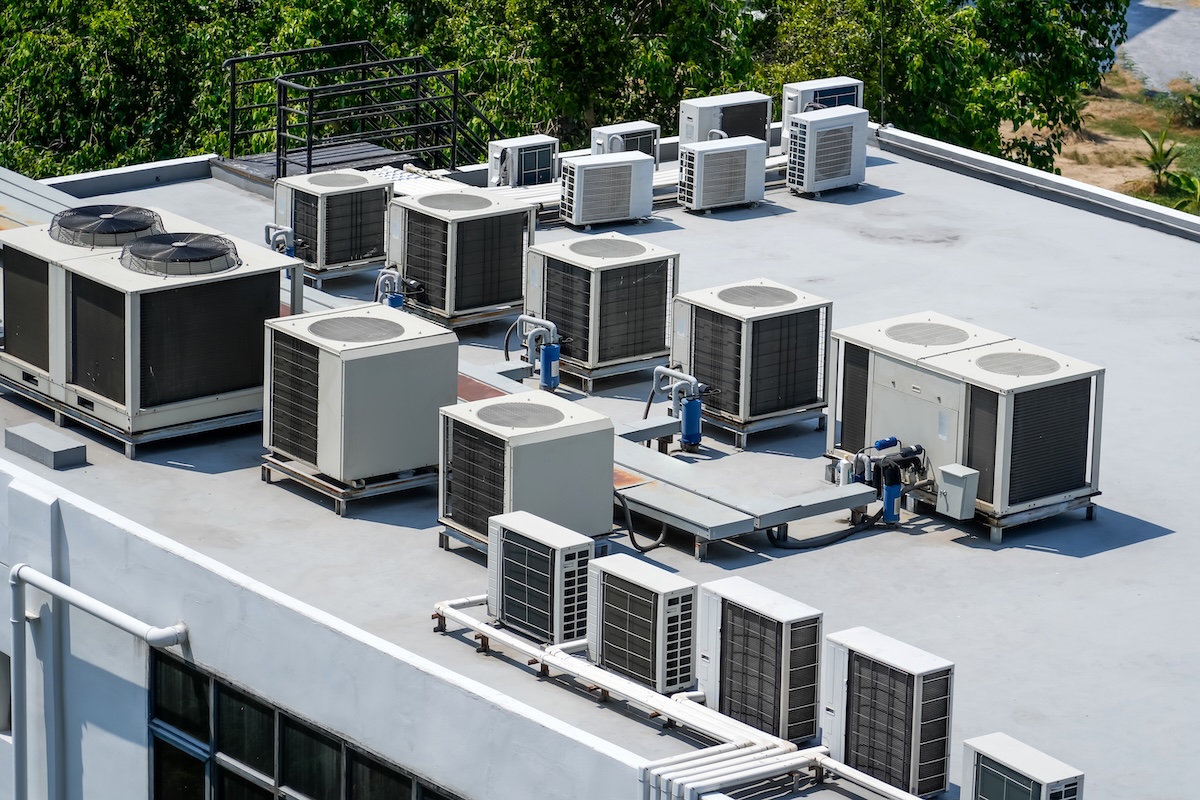
HVAC coordination at Omaha Class A office buildings requires managing equipment outages across both a significant heating season and a hot summer cooling season. Union Pacific's headquarters tower and Mutual of Omaha's campus buildings run full HVAC year-round, and there is limited opportunity for equipment outages without tenant impact. The standard approach is to schedule all equipment curb reflashing work in the May or September shoulder seasons, when outside temperatures allow brief system outages without immediate occupant impact, and to maintain HVAC rental equipment on standby for any outage that extends beyond the planned window. Post-reconnection testing documentation should be provided to the building engineer as part of the project record.
Nebraska's commercial energy code adopts the IECC's Climate Zone 5 provisions for the Omaha area, requiring minimum R-25 above-deck insulation for commercial construction and cool roof compliance on re-roofing projects that trigger full energy code applicability. OPPD and MidAmerican Energy both offer commercial efficiency rebates for insulation upgrades beyond the code minimum, and the combination of R-30 above-deck polyisocyanurate with a white TPO membrane at SRI 90 meets both energy code requirements and efficiency rebate eligibility. The payback on insulation upgrades in Omaha's Climate Zone 5 energy profile — dominated by heating costs in winter and cooling costs in a hot summer — is typically five to seven years depending on current utility rates.
Lease obligations at Omaha Class A buildings are influenced by the Nebraska commercial insurance market's increasing requirements for documented hail resistance. Douglas County's position in the North American hail belt means that hail events exceeding two inches in diameter occur multiple times per decade, and the commercial property insurance market has repriced Omaha office building coverage based on whether the roofing system carries documented FM hail resistance ratings. Mutual of Omaha's landlord obligations at leased campus properties include maintaining FM Approval documentation for the buildings' roofing systems, and lease provisions at Union Pacific-occupied properties typically include equivalent requirements. A re-roofing project that upgrades to an FM 1-90 or 1-120 rated assembly satisfies both the lease covenant and the insurance requirement simultaneously.
Cool membrane specifications for Omaha Class A buildings involve balancing summer cooling load reduction with winter heating conservation in a Climate Zone 5 energy profile. A white TPO at SRI 90 is the appropriate specification for the downtown Omaha high-rise towers, where large internal heat loads from occupancy and systems equipment make the cooling season roof contribution significant. The suburban campus buildings of Mutual of Omaha, with lower internal heat loads and a larger proportion of perimeter glass, may benefit from a medium-reflectance specification that provides year-round energy balance. An energy model specific to the building's actual heat load profile is the most reliable basis for this specification decision.
Rooftop terraces and amenity spaces are an increasing feature of Omaha's Class A office renovations, as building owners compete for corporate tenants who prioritize employee experience. Any re-roofing project that includes a rooftop terrace addition must specify a root-resistant waterproofing membrane beneath the paver or planting system, with the membrane water-tested before any overburden is placed. Walking pad routes from stair access doors to HVAC equipment and from the stair access to the terrace amenity space should be specified in the roofing design so that the walking pads are installed simultaneously with the membrane rather than added as an afterthought that compromises membrane integrity.
Selecting a roofing contractor for an Omaha Class A office building requires verifying their Nebraska contractor license, their FM hail resistance documentation experience, their occupied-building protocol compliance with the specific tenant standards applicable to the project, and their references from comparable Omaha-market Class A office projects. The Nebraska commercial roofing market has a competitive base of experienced contractors, and selection should emphasize specific project type experience over general roofing volume. Request copies of the contractor's FM Approval documentation from comparable recent projects, and contact the respective building managers to confirm the contractor's compliance with tenant construction protocols.
- What hail resistance is required for Class A office roofs in Omaha?
- Douglas County's position in the North American hail belt, combined with increasing insurance market documentation requirements, effectively mandates FM Approval 1-90 or 1-120 impact resistance ratings for Class A Omaha office buildings. Major tenants like Union Pacific and Mutual of Omaha negotiate lease provisions requiring this documentation from their landlords.
- What energy code applies to Omaha Class A office re-roofing?
- Nebraska's adopted IECC Climate Zone 5 requires R-25 minimum above-deck insulation and cool roof compliance at SRI 75 on re-roofing projects triggering full code applicability. Upgrading to R-30 qualifies for OPPD and MidAmerican Energy commercial efficiency rebates, with payback typically five to seven years in Omaha's dual heating-and-cooling climate.
- What Mutual of Omaha construction protocol standards apply to campus re-roofing?
- Mutual of Omaha's campus master maintenance standards specify insurance minimums, noise curfews, air quality testing during demolition, and post-completion inspection procedures. Review these standards before bidding. Failing to comply creates scope additions and compliance costs that eliminate any price advantage, so experienced Omaha contractors factor them into proposals proactively.
- Are green roofs viable for Omaha Class A buildings?
- Yes, with appropriate species selection. Specify native Great Plains plants selected for hail tolerance and drought resilience, with growing medium depth sufficient to protect root masses during Douglas County hail events. An energy model and structural assessment should precede any green roof specification on an existing Omaha office building.
- When is the best construction window for an Omaha office re-roof?
- July through September is the optimal window, after the peak April-June severe weather season. Schedule all HVAC curb reflashing in May or September shoulder-season months. October work carries early freeze risk and requires daily weather monitoring. Begin the Nebraska contractor license and permit verification process six to eight weeks before planned construction.
Frequently asked questions
My BUR roof is 30 years old. Should I recover or replace it?
Age alone does not determine the answer — insulation condition and ply integrity do. A 30-year BUR with dry insulation and intact plies is a strong candidate for modified bitumen cap sheet recover. A 30-year BUR with saturated insulation across large areas needs replacement. We pull moisture cores to give you the actual answer, not the one that sells the most work.
How long does BUR repair typically take on a Downtown Omaha building?
Targeted BUR repair — flashing replacement at parapets and penetrations, blister repair, crack routing and fill — typically runs 2-5 days for a 20,000-30,000 sq ft roof. Full recover with modified bitumen cap sheet runs 1-2 weeks for the same footprint. Access and permitting on Downtown Omaha buildings (crane, lane closure, parking permit) can add pre-mobilization time of 2-3 weeks.
Can you repair a BUR roof in Omaha winter?
Hot-mopped BUR and torch-applied modified bitumen require substrate temperatures above 40°F for proper adhesion. Cold-applied bituminous repair products can be applied at lower temperatures. Emergency temporary repairs — stopping an active leak — can be done with cold-applied materials in any weather. Permanent BUR repair and recover is scheduled for April through October in most years.
BUR inspection or scope for your Omaha building?
We will walk the roof, pull cores where the condition warrants it, and deliver a written condition report with a repair, recover, or replace recommendation — and the reasoning behind it.
Ready to talk through a roof?
Tell us about the building and the roof problem. We'll document it and put a plan in writing — with an honest repair-vs-replace recommendation and no upsell pressure.