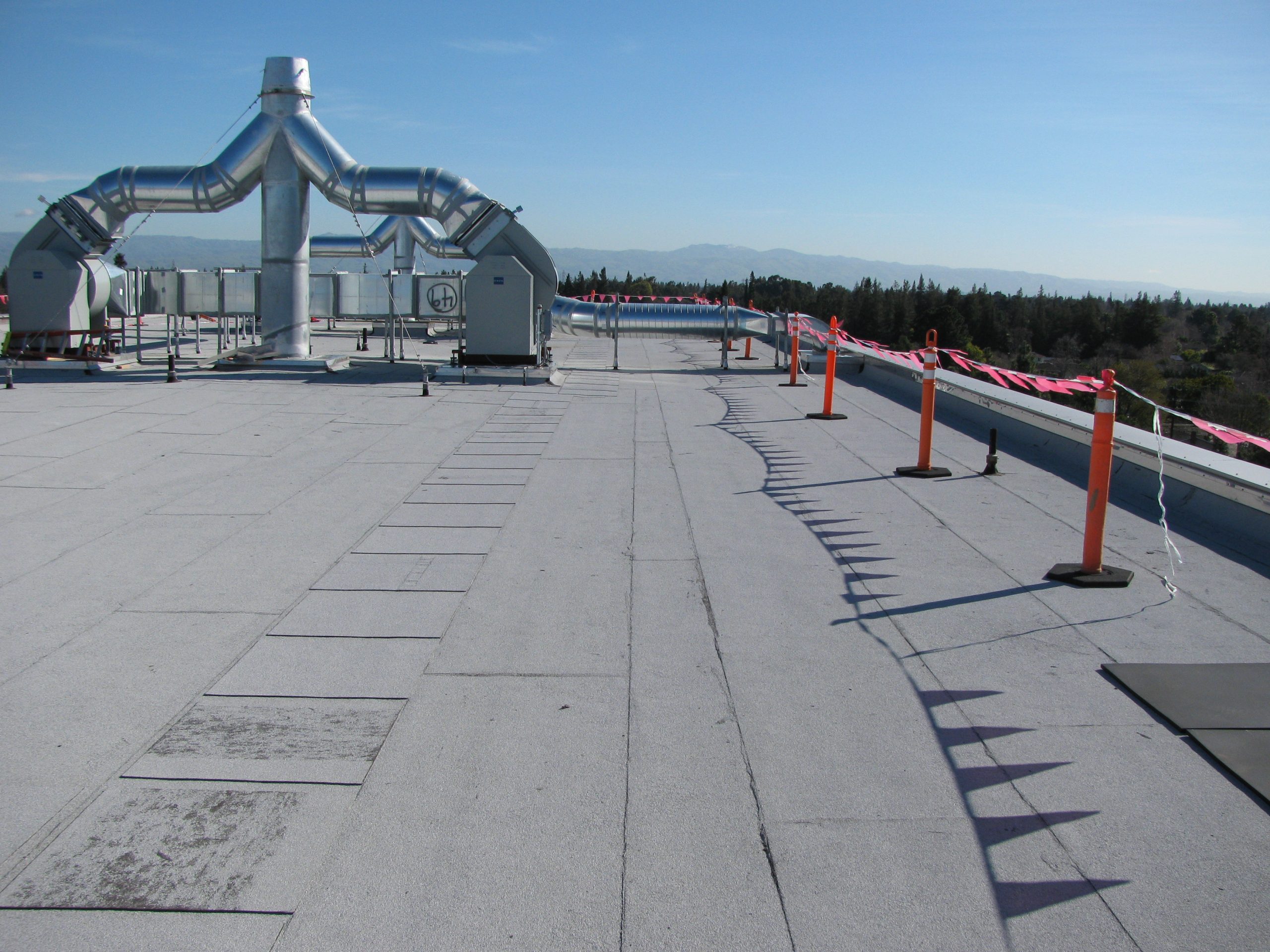
TPO (thermoplastic polyolefin) is the workhorse single-ply membrane for Omaha commercial flat roofs. It reflects summer heat — relevant in an Omaha July when dark roof surfaces exceed 155°F — welds reliably with hot-air seam tools, holds up against UV degradation better than older PVC formulations, and carries 20-year NDL manufacturer warranty paths from every major manufacturer (GAF, Carlisle, Johns Manville, Sika Sarnafil, Versico, Firestone).
We install TPO mechanically attached, fully adhered, or ballasted depending on building use, wind exposure category, and the manufacturer's design package. Most Omaha TPO work is mechanically attached on tapered ISO over metal deck — the configuration that handles the metro's wind uplift demands and the thermal cycling from -25°F January lows to 95°F August highs at the lowest installed cost per square. Fully adhered systems are specified where wind uplift is the limiting design constraint, particularly on West Omaha sites with open I-680 corridor exposure.
TPO Membrane Thickness — 60-mil vs 80-mil
60-mil TPO is the volume-grade specification for Omaha commercial buildings — adequate for most warehouse, retail, and office buildings with normal foot traffic and standard rooftop equipment. Carries a 20-year manufacturer NDL warranty from every major manufacturer.
80-mil TPO costs more per square but extends warranty life (up to 25 years from some manufacturers), handles higher mechanical-traffic environments, and provides additional puncture resistance. We spec 80-mil for buildings with heavy rooftop equipment, for UNMC or Nebraska Medicine campus buildings where maintenance traffic is constant, and for owners who want the longer warranty term and lower 30-year lifecycle cost.
Attachment Methods — Mechanical, Fully-Adhered, Ballasted
Mechanically attached: Most common in Omaha. Membrane fastened with screws and plates through the membrane and insulation into the deck on a pattern designed against the building's wind-uplift requirement. Open-exposure sites on the west side of the metro and near Eppley Airfield require denser fastener patterns than the sheltered urban core.
Fully adhered: Membrane bonded to the substrate with a TPO-compatible adhesive. Used when wind-uplift requirements exceed what mechanical attachment can deliver, when the deck cannot tolerate additional penetrations, or when the project needs the cleanest aesthetic without fastener telegraphing through the membrane. Adhesive application requires substrate temperatures above 40°F — scheduling this system in late October through March requires thermal monitoring.
Ballasted: Membrane loose-laid with rounded stone ballast on top. Rare in modern Omaha commercial work — most buildings cannot tolerate the structural load, and snow loading on top of ballast creates concentrated dead load that older structures were not designed for.
Common TPO Failures in the Nebraska Climate
Seam failure at freeze-thaw cycling: TPO seams are heat-welded. Nebraska's freeze-thaw cycles — the metro sees 50-70 freeze-thaw events per year — stress seams that were marginally welded at installation. Cold welds or incorrect roller pressure during installation create failures that show up within two to three winters. Our welder operators are factory-trained, we test every seam with a 5-lb test wheel during installation, and we run probe-test on every linear foot of seam before closeout.
Flashing detail failure at parapets: Parapets in the Omaha climate see the most thermal movement of any roof component. A brick parapet cycling between -25°F and +100°F moves significantly — more than a generic flashing detail can handle. We specify high-elongation flashing details at parapets and use flexible flashing membranes rated for the full thermal range.
Hail puncture on 45-mil systems: The pre-2010 generation of TPO at 45-mil thickness is vulnerable to puncture from the 1.5-2.5 inch hail events that move through Douglas County most springs. We spec walkway pads on every traffic path identified during inspection, and we recommend upgrading to 60-mil or 80-mil on any recovering project where the existing 45-mil membrane is in place.
Frequently asked questions
What manufacturer of TPO do you install?
We are manufacturer-agnostic. We install systems from GAF, Carlisle, Johns Manville, Sika Sarnafil, Versico, and Firestone. The right manufacturer for your Omaha building depends on warranty terms, available formulation thicknesses, and what your owner's roof asset standard specifies. We recommend based on those criteria, not on what we have in the warehouse.
Can TPO be installed over an existing roof?
Yes, if the existing roof's insulation is dry and the deck is sound. We pull moisture cores during inspection to verify the recover path. Omaha's freeze-thaw cycling is hard on saturated insulation — if cores read wet across more than 25% of the roof area, recovering traps that moisture, which accelerates insulation degradation and voids the new manufacturer warranty. In that case replacement is the honest scope.
How long does TPO last in Omaha's climate?
Modern 60-mil TPO formulations are warranted for 20 years and typically perform 25-30 years with documented annual maintenance. The Nebraska freeze-thaw envelope is harder on flashings and terminations than on the field membrane itself — a 20-year TPO roof in Omaha often needs flashing work at years 10-12 even if the field membrane is in good condition. We document this at the annual maintenance visit so owners can plan the flashing spend before it becomes a leak.
Scoping a TPO project for an Omaha building?
We will walk the roof, document existing conditions, and produce a TPO scope (replacement or recover) with manufacturer warranty path and installed-cost band.
Ready to talk through a roof?
Tell us about the building and the roof problem. We'll document it and put a plan in writing — with an honest repair-vs-replace recommendation and no upsell pressure.