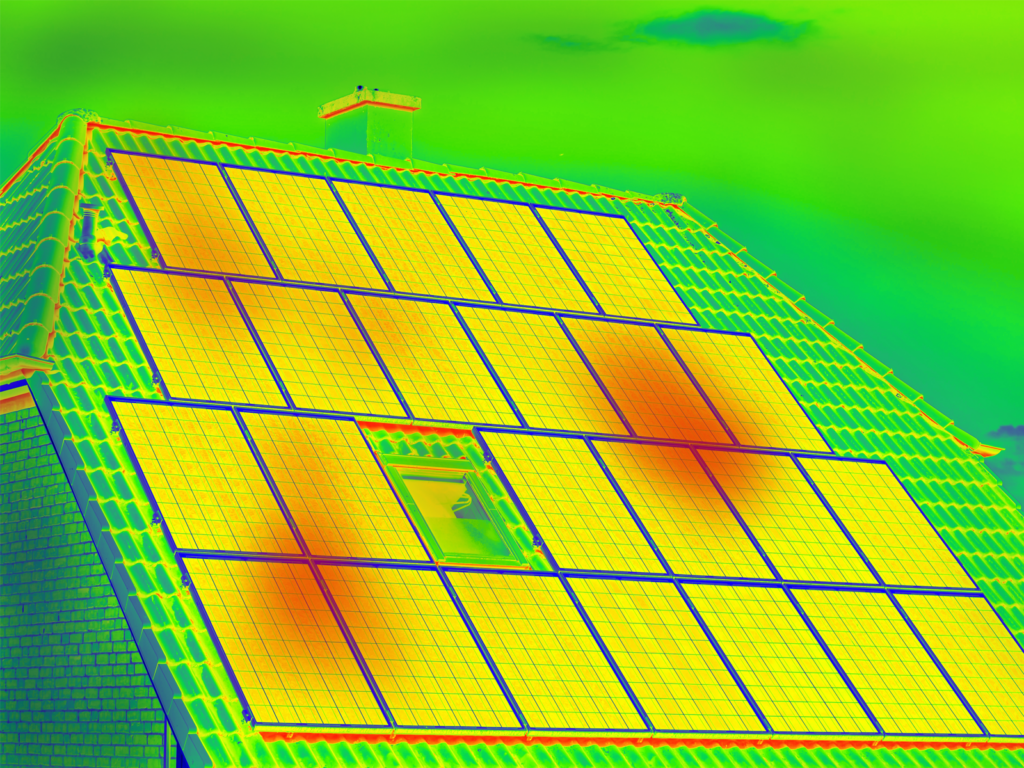
When Infrared Scanning Changes the Scope Decision
Recover versus replace is the most consequential cost decision on an aging commercial roof. Recovering over dry insulation — adding new membrane and insulation on top of the existing assembly — can extend roof life 15 to 20 years at roughly half the capital cost of full tear-off and replacement. Recovering over saturated insulation traps the moisture, accelerates insulation degradation, and voids the new manufacturer warranty within a few years.
The standard for recover eligibility is a moisture survey that shows fewer than 25% of the roof area has saturated insulation. Without infrared scanning, this decision gets made by visual observation and spot-core pulls — a method that is accurate at the core locations and unreliable everywhere else. A scan covers 100% of the roof surface and identifies every wet zone, not just the ones a contractor guessed at during the core-pull layout. On a 100,000-square-foot industrial building along the I-80 corridor, the difference between a scan-confirmed recover and a mislabeled tear-off is $400,000 or more.
The scan also identifies the wet zones precisely enough to guide targeted insulation replacement. If 15% of the roof is saturated — scattered in identifiable zones — we can replace insulation at those zones, confirm dryness with a post-remediation scan, and recover the entire roof with a clean warranty path. That level of precision is not available from core pulls alone.
Scanning Conditions in the Omaha Climate
Effective infrared scanning requires a clear sky, no precipitation for 24 hours preceding the scan, and a minimum 10°F differential between the roof surface temperature and the ambient air temperature at scan time. Omaha's climate produces good scanning conditions in late spring, summer, and early fall — the April-through-October window is when we schedule most scans. Winter scanning is possible during clear cold periods when the thermal differential is large, but the shorter daylight window and the risk of precipitation restrict the scheduling.
Wind affects scan quality. High wind carries heat off the roof surface uniformly, reducing the thermal contrast between wet and dry zones. We monitor wind conditions and reschedule rather than deliver a compromised scan. Omaha's afternoon wind is typically lighter in the late summer evenings when scanning starts — most of our Omaha scans run without wind interference.
Rain preceding the scan contaminates results by wetting the surface and creating false anomalies. We require a 24-hour rain-free window before the scan date. This can require rescheduling on short notice during Omaha's spring storm season — we notify clients as soon as a weather conflict appears.
Deliverables — The Moisture Map Report
The deliverable is a PDF report with a roof zone diagram overlaid with the moisture anomaly map, infrared and visible-light photo pairs for each anomaly zone, core-pull correlation data, and a written assessment that identifies the total wet-zone area as a percentage of the roof footprint and provides a recover-versus-replace recommendation.
The report is formatted to support the owner's capital planning process. If the scan confirms recover eligibility, the report includes a notation of the wet zones that need targeted insulation replacement before recover. If the scan shows saturation beyond the recover threshold, the report documents the finding clearly enough to support a full replacement scope and a manufacturer warranty application.
We also provide the scan data in digital format — geo-referenced infrared images that can be imported into a building's roof asset management system. For larger commercial portfolios with multiple Omaha buildings, the digital format allows overlay against prior-year scans to track moisture progression.
Frequently asked questions
Does infrared scanning replace core pulls entirely?
No — infrared identifies anomaly zones; core pulls confirm whether the anomalies are moisture, entrapped air, or debris. We always pull cores at representative anomaly locations to validate the scan. But the scan directs where the cores go, which dramatically reduces the number of cores needed and produces results that cover the entire roof rather than a sample of discrete points.
What building types does infrared scanning work for?
Any commercial flat or low-slope roof with membrane over insulation — TPO, EPDM, PVC, modified bitumen, or built-up systems. Ballasted roofs require removal of ballast at scan locations and are less practical to scan. Metal roofs with no insulation assembly do not produce the thermal-mass differential infrared scanning relies on. Most commercial flat-roof inventory across Omaha — the warehouse and distribution buildings in the I-80 corridor, the office buildings along Dodge Street, the medical buildings near UNMC — is well-suited to infrared scanning.
How long does a scan take?
Scanning a 50,000-square-foot roof takes approximately 90 minutes from start to completion at the scan window. Larger roofs — 100,000 square feet or more — require multiple scan windows or an extended single session. We schedule scan windows starting 90 minutes after sunset and work until the thermal differential narrows. Report turnaround is typically five to seven business days from the scan date.
Schedule an infrared moisture scan for your Omaha building.
We map wet insulation zones with thermal imaging, confirm with core pulls, and produce a moisture report that drives a defensible recover-versus-replace decision.
Ready to talk through a roof?
Tell us about the building and the roof problem. We'll document it and put a plan in writing — with an honest repair-vs-replace recommendation and no upsell pressure.