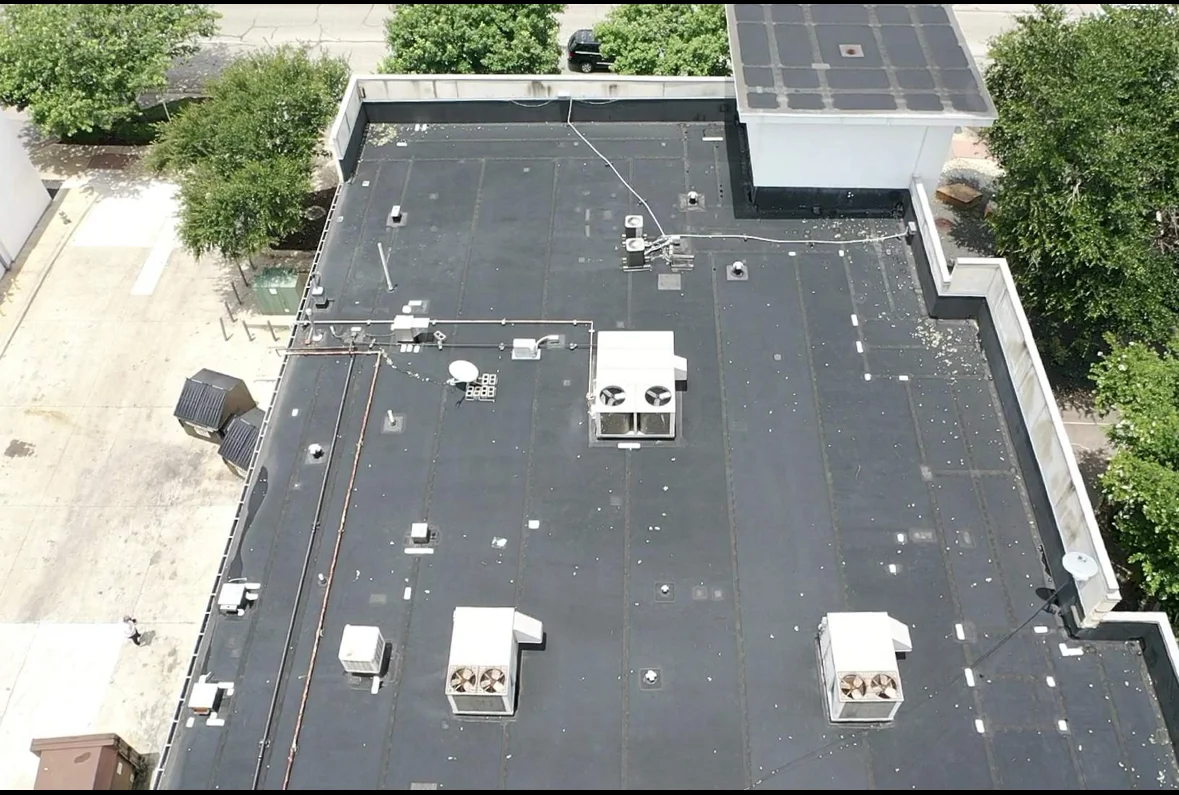
EPDM (ethylene propylene diene monomer) is the proven long-cycle commercial membrane for Omaha industrial and heavy-use buildings. It handles Nebraska's -25°F winter lows without embrittlement, resists the UV exposure of the Nebraska summer, and has a documented 30-plus-year service life when properly maintained.
EPDM has been the primary commercial flat roofing membrane in the Omaha industrial market since the 1980s. The warehouse and distribution buildings along the North Omaha river bottom, the manufacturing facilities in the I-80 corridor, and a significant portion of the Eppley Airfield-adjacent industrial zone run original or recovered EPDM systems. We know this membrane category the way Omaha contractors know it: through extensive installation, repair, and recover work on buildings that have been through every weather event the Nebraska climate can produce.
Modern EPDM formulations are available in 45-mil, 60-mil, and 90-mil thickness. The 60-mil system is the standard commercial specification for most Omaha buildings — adequate for industrial foot traffic and Nebraska's freeze-thaw cycling, with 20-year manufacturer warranty paths from Carlisle, Firestone, and Johns Manville. The 90-mil system is specified for buildings with heavy mechanical traffic, for roofs where puncture resistance is the primary design concern, or for owners who want the longest available warranty term.
EPDM's single practical limitation relative to TPO is its black color — it absorbs heat rather than reflecting it. An uncoated black EPDM surface in an Omaha July runs 155-170°F. For buildings where cooling load is a primary operational cost, we specify white TPO or a reflective coating over EPDM rather than standard black EPDM. For industrial buildings where the cooling load is not significant — manufacturing facilities, cold-storage warehouses, distribution centers — EPDM's heat absorption is not a meaningful drawback.
EPDM in Nebraska's Freeze-Thaw Environment
EPDM's principal advantage in the Omaha climate is its low-temperature flexibility. The membrane remains pliable and dimensionally stable at -25°F — the historic low temperature recorded at Omaha's Eppley Airfield. TPO, by comparison, becomes more brittle at sustained sub-zero temperatures and is more susceptible to cracking under foot traffic in cold conditions. For Omaha industrial buildings where maintenance crews are on the roof in January clearing snow or servicing HVAC equipment, EPDM's cold-temperature performance is a meaningful specification advantage.
EPDM also handles the full thermal cycling range — the same membrane that survives a Nebraska winter at -25°F is on the same roof surface that reaches 160°F in July. The EPDM formulation's elongation (stretching) properties mean it cycles through these extremes without the cumulative dimensional stress that affects less elastic membranes. Seam adhesive on EPDM systems — spliced with EPDM lap splice adhesive rather than heat-welded — also performs well through the thermal range.
The one freeze-thaw vulnerability on EPDM systems is the lap seam. Spliced seams require proper primer, adhesive coverage, and roller pressure at installation. Marginally spliced seams open under the thermal cycling of the first two to three Nebraska winters. We test every lap seam with a seam probe after adhesive cure before any section of field membrane is covered with ballast, coverboard, or overlay.
EPDM Repair — What Holds and What Does Not
Punctures and tears in EPDM field membrane are repaired with EPDM patch and lap splice adhesive — the same chemistry as the original installation. A properly prepared and adhered patch on clean, primed EPDM is a permanent repair when executed correctly. The failure mode on EPDM patches is almost always surface preparation: the membrane was not cleaned of dirt and oxidation before primer was applied, or the adhesive was applied too wet or in temperatures below the adhesive minimum. We have seen 'repairs' on Omaha industrial buildings that peeled off in the first freeze-thaw cycle because the surface was never properly prepped.
Seam re-splicing on aged EPDM: EPDM that has been in service for 15-plus years has a surface that is partially oxidized. Oxidized EPDM does not accept lap splice adhesive the same way new membrane does — the primer and adhesive chemistry for aged EPDM requires a different formulation than the original installation chemistry. We specify the correct primer and adhesive for the membrane age and condition on every re-splice repair. The Mutual of Omaha campus and the CHI Health administrative buildings in the Dodge Street corridor both have EPDM inventory from the mid-1990s — this is active repair territory where the chemistry matters.
EPDM Over Derecho-Damaged Substrates
The August 2020 derecho produced a specific EPDM failure pattern on the distribution buildings near Eppley Airfield and along the North Omaha river bottom: membrane blow-off on fully adhered systems where the adhesive bond had been partially compromised by prior moisture intrusion, and ballast displacement on ballasted systems where the stone had been underspecified for the open-exposure wind conditions. We documented and repaired EPDM systems on several of these buildings in the weeks after the event.
The forensic question on derecho-damaged EPDM is whether the failure was wind damage — covered by commercial property insurance — or installation defect aggravated by wind. A mechanically attached system that failed because the fastener pattern was undersized for the building's actual exposure category is an installation defect, not storm damage, regardless of the wind speed. We document both failure modes accurately in our written assessments, because the distinction determines whether the building's insurance responds or whether the owner is looking at an uninsured replacement.
Frequently asked questions
How long does EPDM last on an Omaha commercial building?
A properly installed and maintained 60-mil EPDM system is warranted for 20 years and typically performs 25-30 years in Nebraska's climate. The first maintenance milestone is usually flashing work at year 10-12 — the field membrane often remains sound while the parapet flashings and penetration details show freeze-thaw fatigue. We document this at the annual maintenance visit so the flashing spend is planned rather than reactive.
Is EPDM or TPO better for my Omaha commercial building?
The right answer depends on the building's use, the cooling load, the rooftop traffic pattern, and the warranty path the owner wants. EPDM is better for heavy-use industrial buildings in cold-climate applications where low-temperature flexibility matters. TPO is better for buildings where reflectivity and cooling load are significant, and where the heat-weld seam system (rather than EPDM's adhesive seam) is preferred for long-term seam performance. We spec both and recommend based on the building.
Can EPDM be recovered rather than replaced?
Yes, when the existing EPDM substrate is dry and in structurally sound condition. We pull moisture cores to verify. A recover with new insulation and a 60-mil EPDM or TPO system over a dry EPDM substrate can add 20 years at roughly 50-60% of full replacement cost.
Scoping EPDM work on an Omaha commercial building?
We will walk the roof, assess the existing system, and give you a written scope — installation, recover, or repair — with manufacturer warranty path and timeline.
Ready to talk through a roof?
Tell us about the building and the roof problem. We'll document it and put a plan in writing — with an honest repair-vs-replace recommendation and no upsell pressure.