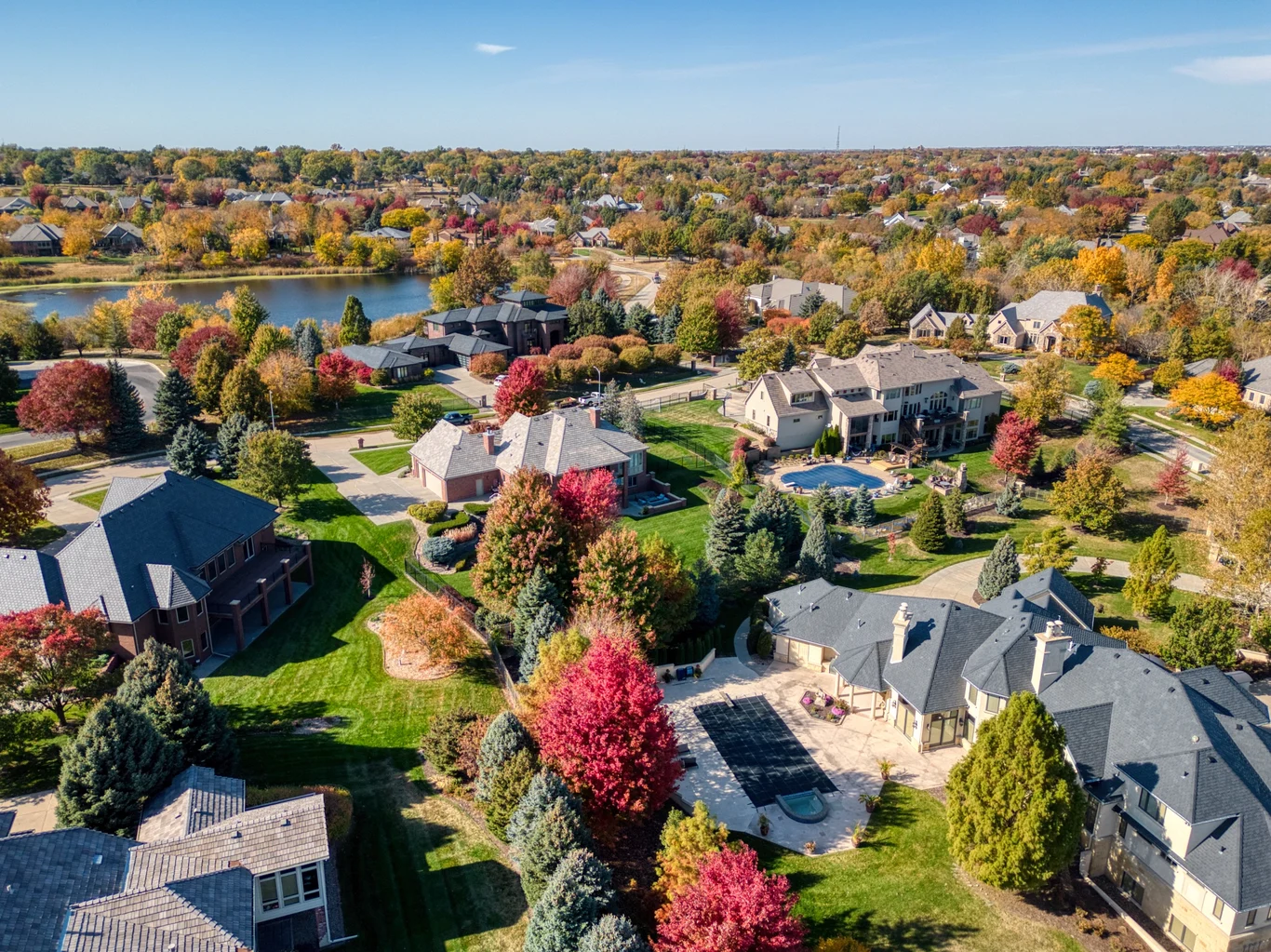
The I- west to the Gretna interchange holds the largest concentration of distribution and warehouse construction in the Omaha metro. These buildings have large flat-roof footprints, open-exposure wind conditions, and replacement cycles that have been active since the early 2000s.
The I-80 corridor in West Omaha — the industrial and distribution parks that cluster around the interstate interchanges from 72nd Street west through 90th, 108th, 120th, 144th, and out to the Gretna interchange in Sarpy County — is the freight and logistics spine of the Omaha metro. The warehouse and distribution buildings in this zone have some of the largest flat-roof footprints in the region: 100,000 to 500,000 sq ft structures on low-slope metal deck systems, most built between 1985 and 2010.
The roof replacement cycle on West Omaha I-80 industrial buildings is active. Buildings from the 1985-2000 era are on second or third reroof. Buildings from the 2000-2010 era are approaching their first major replacement cycle. New construction continues in the logistics parks around the 168th Street interchange and west into the Sarpy County fringe. We run inspection routes through this corridor on a regular basis and maintain roof history on the buildings we have accessed.
Wind Uplift on the I-80 Industrial Corridor
The I- is open suburban terrain — no downtown density to reduce wind exposure. Buildings along the interstate are in Exposure B conditions at a minimum, with some open-site locations qualifying as Exposure C under ASCE 7 wind load provisions. The design wind-uplift requirement for a 300, I-80 interchange is significantly higher than for a similarly sized building in a sheltered urban block.
The August 2020 derecho exposed the consequences of underspecified fastener patterns in this corridor. Several I-80 distribution buildings experienced membrane blow-off on sections where the mechanically attached TPO had been installed with fastener patterns adequate for sheltered urban conditions but insufficient for the building's actual exposure. We correct this on every replacement project by calculating wind-uplift from the site's actual terrain category and exposure classification, not from a generic standard-exposure template.
Perimeter and corner zones on large industrial buildings are the highest uplift areas. On a 400-foot-wide distribution building, the corner zones specified under ASCE 7 can require three to four times the fastener density of the field. Generic replacement scopes that apply a single fastener pattern across the entire roof field are technically deficient at the corners and perimeter, even if they look adequate in the middle of the building.
Large-Footprint Industrial Replacement Logistics
Replacing a 200,000-plus sq ft industrial roof requires a sequencing plan that keeps the building dry throughout production. We work in sections — 10,000 to 20,000 sq ft per day depending on crew size and membrane system — with same-day dry-in on every section. On a 200,000 sq ft roof at 15,000 sq ft per day, production runs approximately 13 production days plus weather days. We give a written production schedule before contract signing, with the daily section sequence, the dry-in plan for each section, and the identified weather contingency windows.
Occupied distribution buildings — buildings with active inventory and warehouse operations below the roof — require production sequencing that avoids disrupting the dock doors, the forklift lanes, and the inventory areas. We work with the building's warehouse manager to identify the production sequence that causes the least operational interference. Tear-off sections are planned around the dock activity schedule where possible.
Material delivery to I-80 corridor industrial buildings is simpler than Downtown: these sites have large paved lots, loading docks, and space for material staging. Full semi-loads of TPO membrane, insulation, and equipment can be delivered and staged at the building perimeter without the logistical constraints of urban sites.
The Gretna and La Vista Interchange Fringe
The I-80 corridor extends west into Sarpy County — the Gretna interchange at Exit 432 has seen significant new construction in the logistics park that opened around 2018-2020. These are the newest large-format industrial buildings in the metro: most on 60-mil or 80-mil TPO at high wind-uplift specifications. We service these buildings as part of our West Omaha I- office to the Gretna interchange is 35-40 minutes.
La Vista's industrial and commercial zone at the I-80 and I-680 interchange cluster — the La Vista Conference Center and the surrounding commercial buildings — is also part of our I-80 corridor territory. We hold active accounts in La Vista and treat it as part of the same inspection route as the West Omaha I-80 industrial zone.
Frequently asked questions
What is the right wind uplift specification for a West Omaha I-80 distribution building?
It depends on the specific site's exposure classification under ASCE 7. Most I-80 corridor industrial sites are Exposure B; open-field sites at the western fringe near the Gretna interchange can qualify as Exposure C. We calculate wind-uplift from the site-specific terrain category and design the fastener pattern accordingly — not from a generic template.
How long does it take to replace a 200,000 sq ft industrial roof?
At a production rate of 15,000 sq ft per day with same-day dry-in on each section, a 200,000 sq ft roof is approximately 13-15 production days plus weather days. Nebraska's spring tornado season and summer convective storm pattern add weather days to most projects that run from April through August. We give a written production schedule with identified weather contingency windows before contract signing.
Do you work in Sarpy County — La Vista, Gretna, Papillion?
Yes. Sarpy County is part of our regular service corridor. We hold active accounts in La Vista, Papillion, and the Gretna logistics park. Permits are pulled with the applicable Sarpy County or municipal authority.
West Omaha I-80 industrial or warehouse roof scope?
We scope, replace, and maintain large-footprint industrial roofs along the West Omaha I-80 corridor — with wind-uplift calculations from actual site exposure and production schedules that keep the building dry throughout.
Ready to talk through a roof?
Tell us about the building and the roof problem. We'll document it and put a plan in writing — with an honest repair-vs-replace recommendation and no upsell pressure.