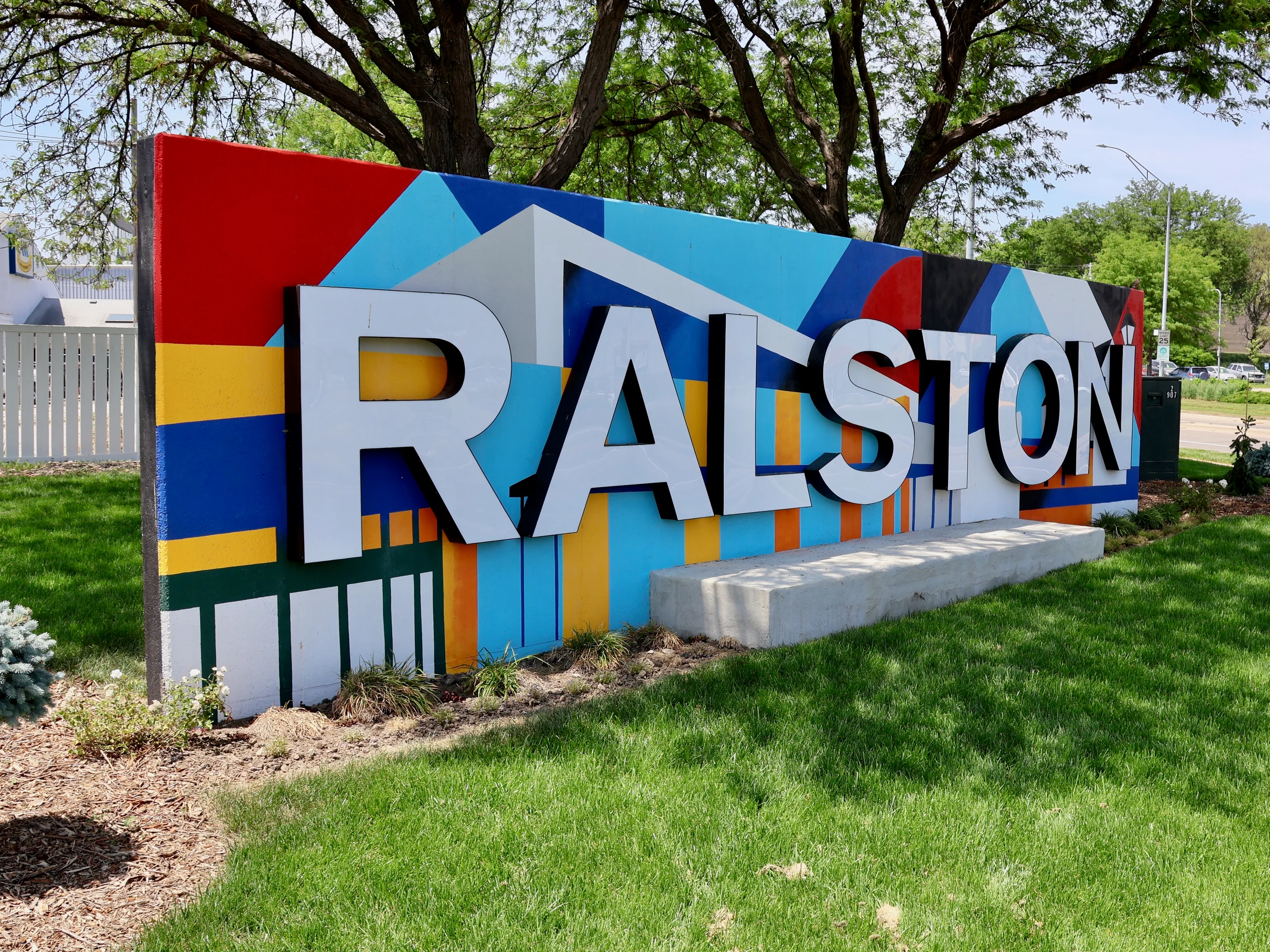
Ralston is one of the few enclave cities in the Omaha metro — it sits fully surrounded by the City of Omaha in south-central Douglas County, bounded roughly by 72nd Street on the east, 84th Street on the west, Q Street on the north, and the Sarpy County line on the south. That location puts Ralston 20- office, which means we can run same-day emergency response to any Ralston commercial building during business hours.
The commercial inventory is compact. The Main Street corridor through the city center carries small to mid-size retail and service commercial, much of it in 1960s through 1980s construction. The Q Street commercial strip along the north boundary handles light industrial and service commercial buildings. The Ralston Arena district near 72nd and Q anchors a cluster of event-related commercial development.
Most Ralston commercial buildings date from the 1960s through 1990s. That age profile means BUR, modified bitumen, and early single-ply systems are common — many of them at or past end of designed service life. The buildings have often been maintained reactively, with patch-on-patch repair that has never been followed by a documented condition assessment or capital plan.
Main Street and Q Street Commercial Corridors
Main Street commercial buildings in Ralston follow the same pattern we see in most metro-area inner-ring suburban commercial corridors: older masonry construction, original BUR or modified bitumen systems, parapet walls that have been caulked and patched repeatedly, and drain systems that were designed for the original roof assembly and have not been updated as layers were added on top of the original system.
The layering problem is significant in this inventory. We find Ralston commercial buildings with three or more roof assemblies stacked — original BUR, a modified bitumen recover from the 1990s, and a torch-applied patch layer from the 2000s. Each layer has trapped moisture in the insulation below it. The combined dead load of those layers can exceed the original structural design load for the roof deck. When we assess these buildings, we include a dead load analysis based on the number of existing layers and the structural capacity of the deck, because the replacement scope may require all layers to come off rather than just the top membrane.
The Q Street industrial corridor carries light industrial and service commercial buildings — auto service, light manufacturing, warehouse — in 1970s and 1980s construction. Many of these buildings have not had a professional roof assessment in years. We see this in the condition of the drain bowls (often cracked and unmaintained), the parapet copings (loose or absent), and the field membrane (heavily alligatored on BUR, or delaminated at termination bars on modified bitumen systems).
Ralston Arena and Event-Adjacent Properties
The Ralston Arena at 72nd and Q Street is the center of a cluster of event-adjacent commercial development — sports bars, casual dining, hotel, and retail that runs on the arena's event calendar. These buildings are relatively recent (2010s construction) and on first maintenance cycles for their TPO systems.
Event-venue buildings in this corridor have elevated HVAC loads during events and high rooftop foot traffic from maintenance staff. We specify and install walkway pad systems on every event-adjacent commercial building we work on — the foot traffic patterns on these roofs without dedicated walkways shorten membrane life significantly. We also pay specific attention to the HVAC condensate drain system, which handles surge loads during summer events and can back up onto the membrane if the drain line is undersized or blocked.
The arena itself is a publicly owned facility that follows city procurement processes. Our work in this corridor focuses on the surrounding private commercial buildings rather than the arena.
Proximity to Omaha — Response Time and Permitting
Ralston is surrounded by Omaha but is an independent incorporated city with its own building department. We pull City of Ralston permits for commercial roof work within Ralston's boundaries — not Omaha permits, even though Ralston is fully enclosed by Omaha. This distinction matters for inspection scheduling: Ralston Building Department inspections are scheduled separately from Omaha Development Services inspections.
Frequently asked questions
Is Ralston commercial roof work permitted through Omaha or through Ralston?
Ralston is an independent city with its own building department. We pull City of Ralston permits for commercial work within Ralston's boundaries — not Omaha permits. Even though Ralston is surrounded by Omaha, it has separate permitting and inspection authority.
What is the typical condition of older Ralston commercial roofs?
We find a high proportion of multi-layer assemblies — original BUR with one or two subsequent recovers on top — that have trapped moisture in lower insulation layers. Combined dead loads from these assemblies can approach or exceed structural design limits. A proper assessment includes a dead-load analysis and moisture core pulls, not just surface inspection.
How quickly can you respond to a Ralston commercial roof emergency?
20- office in normal traffic. We treat Ralston the same as Omaha urban-core for emergency prioritization — same-day response during business hours is standard.
Ralston commercial roof inspection or scope?
We pull Ralston permits, assess multi-layer assemblies with moisture cores and dead-load analysis, and deliver a written scope with a capital number.
Ready to talk through a roof?
Tell us about the building and the roof problem. We'll document it and put a plan in writing — with an honest repair-vs-replace recommendation and no upsell pressure.