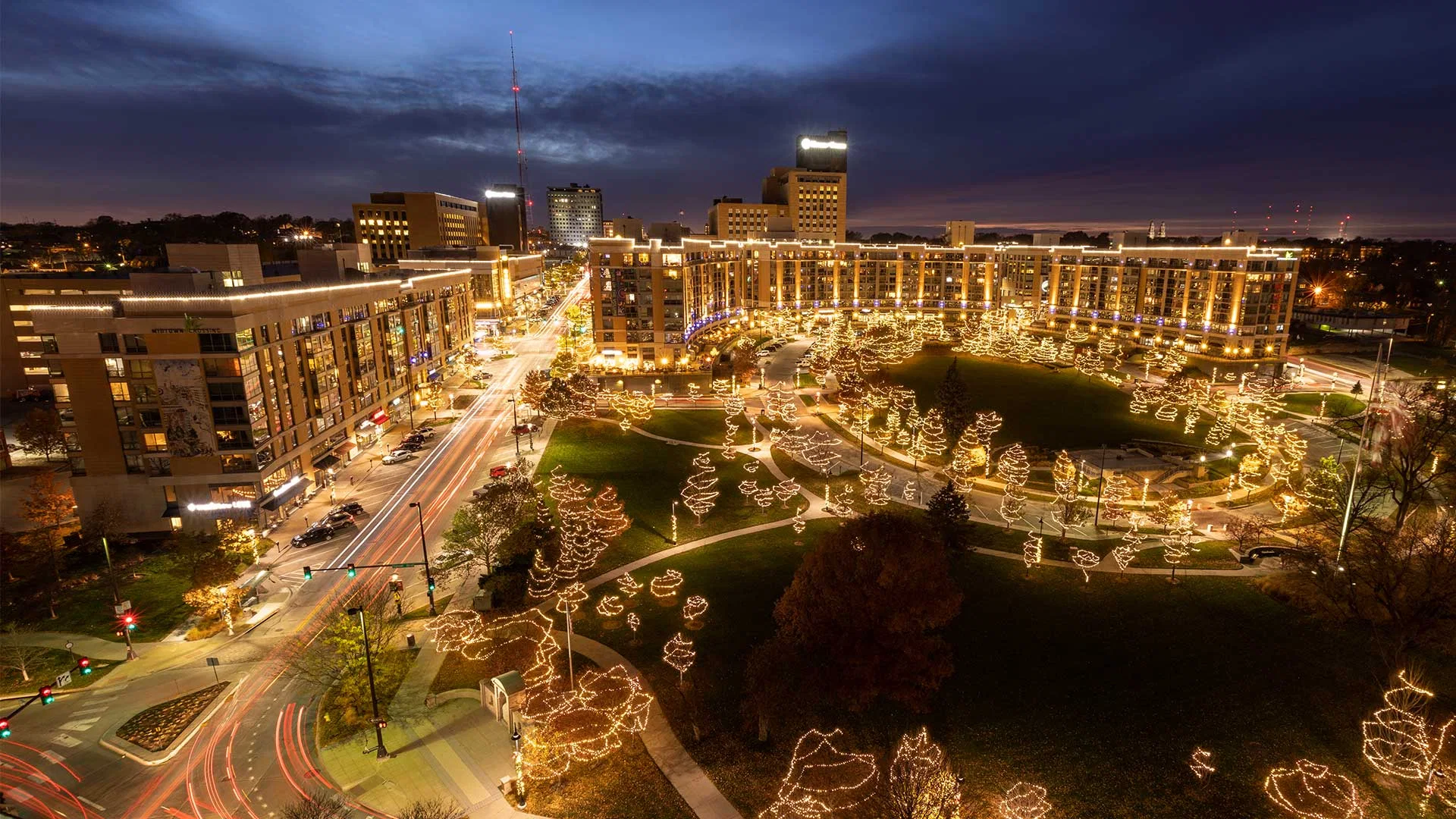
Midtown Omaha's commercial inventory spans extensive construction — from the 1960s and 1970s office and retail buildings along 72nd Street to the Midtown Crossing mixed-use development that opened in 2010. We run regular inspection routes through this corridor.
Midtown Omaha's commercial zone stretches roughly from 42nd Street to 84th Street along the Dodge Street spine, taking in the 72nd Street commercial strip, the medical office and hospital buildings south of Dodge along Leavenworth, and the Midtown Crossing development at 33rd and Farnam that sits at the eastern edge of the Midtown designation.
The age distribution of Midtown commercial roofs is wide. At 72nd and Dodge, you find 1970s office buildings on third-generation modified bitumen alongside 2005-era retail construction on first-generation 60-mil TPO. Along Leavenworth between 42nd and 52nd, the medical office buildings adjacent to Creighton University Medical Center and CHI Health Immanuel represent a mix of institutional construction that requires infection-control-aware project sequencing on occupied floors. We scope each building on its own merits — age, existing system, deck condition, and the operational constraints of whatever happens below the roof.
The 72nd Street Commercial Corridor
The 72nd Street corridor from Dodge Street south to Pacific is one of the densest commercial strips in the metro — retail, restaurant, medical office, professional services, and a handful of mixed-use buildings. The roof inventory along this corridor is a wide age range. Buildings from the 1960s-1970s are on second or third-generation modified bitumen or early-generation EPDM. Buildings from the 1990s are approaching reroof. Buildings from the 2010s are hitting first maintenance cycles.
Strip retail buildings along 72nd Street have a specific drainage vulnerability: multiple rooftop units (RTUs) for the HVAC systems serving the tenant bays create a high-density equipment footprint that makes it hard to run water to the drains. When an RTU curb flashing fails or an equipment pad shifts, the ponding around the unit can stay wet for weeks before it becomes a visible leak. We identify RTU-area drainage issues on every inspection — it is one of the leading sources of hidden moisture accumulation in strip retail buildings.
We cover the Westroads Mall commercial zone as part of the 72nd Street corridor — the Westroads area at 10th and Dodge and the surrounding retail and office buildings at 84th and Dodge. These large-format retail buildings have substantial flat-roof footprints and long spans between drains. Drain maintenance and annual inspection are the most cost-effective spend on these buildings.
Midtown Crossing and the 33rd-42nd Street Medical Zone
Midtown Crossing opened in 2010 at 33rd and Farnam. The development's commercial buildings — retail, office, and the Marriott hotel tower — are now in the 13-15 year range and entering first major maintenance cycles. The hotel tower is a high-rise application with different wind-uplift and membrane considerations than the lower-profile retail and office components. We inspect and maintain the commercial buildings in the Midtown Crossing complex on a documented annual schedule.
The medical zone along Leavenworth Street between 36th and 52nd — the clinical buildings associated with Creighton University Medical Center, the CHI Health Immanuel campus, and the medical office buildings that serve both hospital systems — requires infection-control-aware project sequencing. Any work on occupied medical buildings involves dust and debris containment plans, HVAC intake protection, hot-work permits for any torch or welding work, and pre-construction coordination with the facility team.
We have worked on buildings in the CHI Health system across the metro, and the sequencing requirements are consistent: facility management approval of the project scope and schedule before contract signing, a hot-work permit for any welding or torch work, and a post-construction clean inspection before the building's infection-control officer signs off on the work area.
Emergency Response in Midtown Omaha
Emergency response to Midtown Omaha is same-day from our corridor is 15- corridor is 25-30 minutes. We maintain crews in the field across Midtown during business hours and can route the nearest crew to an emergency call without pulling from a fixed location.
The 72nd Street corridor's strip retail buildings have a specific after-hours vulnerability: interior leaks that develop during evening thunderstorms when the building is unoccupied. Tenant damage from overnight leaks in strip retail is often extensive — inventory, flooring, display fixtures. Buildings on our maintenance contracts get after-hours emergency response and priority scheduling for permanent repair following any emergency dry-in.
Frequently asked questions
Do you work on occupied medical office buildings in Midtown?
Yes. We submit a detailed work plan to the facility management team before mobilization, follow the building's hot-work permit requirements for any welding or torch work, and document dust and debris containment for any work above occupied clinical areas. We have worked on buildings in the CHI Health and Creighton University Medical systems and are familiar with their sequencing requirements.
What is the most common roof issue in Midtown strip retail buildings?
RTU-area drainage failure — water ponding around rooftop unit curbs when the curb flashing deteriorates or the equipment pad shifts, combined with drain paths that are blocked by the equipment footprint. This turns into hidden insulation saturation that shows up as a ceiling stain months after the original failure. Annual inspection that includes RTU-area drainage assessment catches this before the insulation is saturated.
Do you service the 84th Street corridor?
Yes. 84th Street from Dodge south to Pacific is part of our regular Midtown inspection route. Travel time from our Farnam office is 25- corridor and treat it as part of the Midtown service zone.
Midtown Omaha commercial roof inspection or scope?
We inspect, scope, and maintain Midtown commercial roofs — including the strip retail, medical office, and mixed-use buildings along the 72nd Street and Dodge Street corridors.
Ready to talk through a roof?
Tell us about the building and the roof problem. We'll document it and put a plan in writing — with an honest repair-vs-replace recommendation and no upsell pressure.