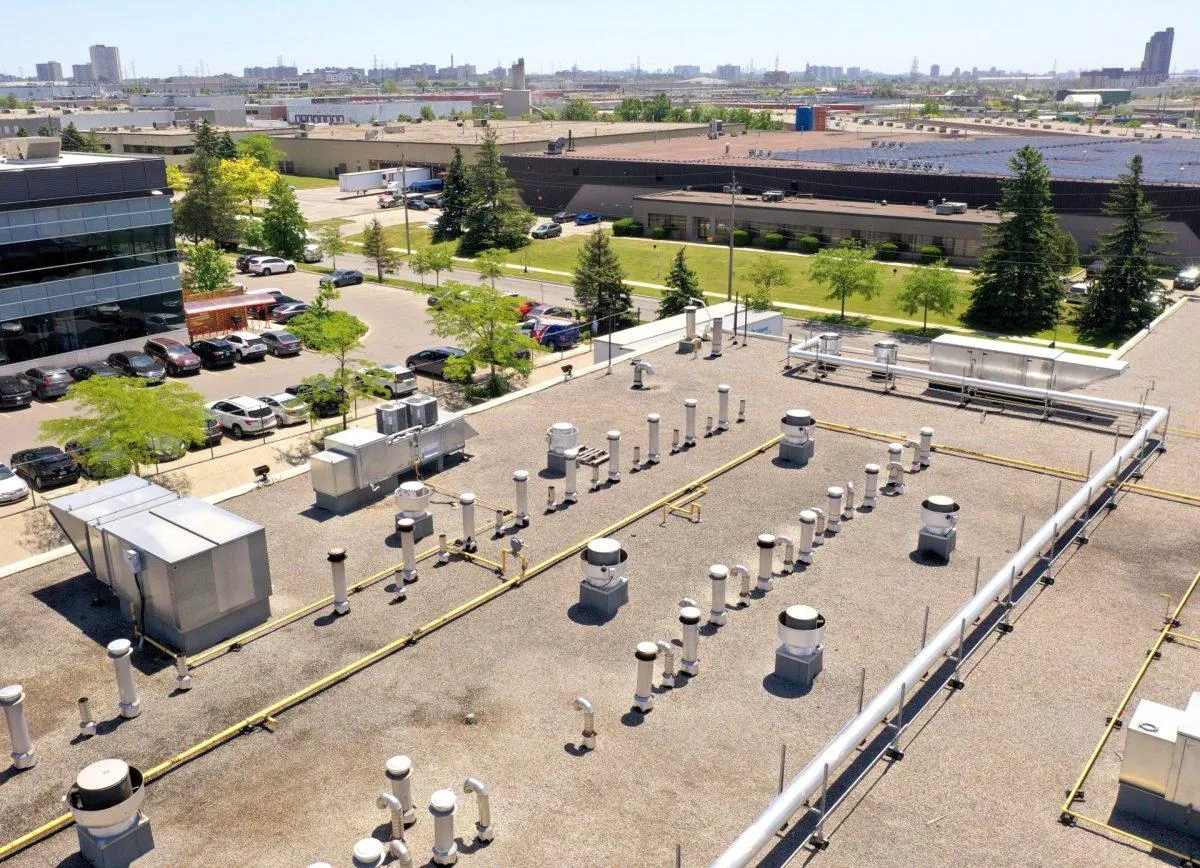
Omaha was built on protein. The Union Stockyards made it a packing town, and the descendants of that industry are still here — meat and poultry processors, cold-storage and distribution houses, dairy and ingredient plants, and bakeries scattered through South Omaha, the Council Bluffs industrial flats across the river, and the rail-served corridors along I-80 and the riverfront. The roofs over those plants take a beating that a dry warehouse roof never sees, and they take it from two directions at once: humidity pushing up from the floor and heavy refrigeration equipment pressing down from above.
Washdown Humidity Is the Quiet Killer
A processing floor gets cleaned with hot water and sanitizer, often every single day, sometimes between every shift. That sanitation cycle fills the space with warm, moisture-laden air, and in a sealed plant that vapor has one place to go: up, into the deck and the insulation above it. Drive that warm wet air against a cold Omaha winter deck and it condenses inside the assembly. The result is corroding steel deck, soaked insulation that loses its R-value, and rusting fasteners — and none of it shows as a ceiling stain until the damage is well advanced. On a food plant the underside of the roof is under attack as relentlessly as the topside, and the fix lives in the assembly: a properly specified and continuously detailed air and vapor barrier matched to the plant's interior humidity and to this climate's vapor drive. Get that layer right and the structure stays dry; get it wrong and no amount of membrane on top will stop the rot.
The Roof Is Also a Refrigeration Platform
Food plants carry weight on the roof that other buildings don't. Refrigeration condensers and large rooftop units serving coolers, freezers, and blast cells, ammonia or glycol lines running across the deck, evaporative equipment, and the maintenance traffic that all of it demands add up to real structural load and a crowded, penetration-heavy roof field. We confirm the deck can carry the equipment and the insulation we propose before we add anything, flash every line and curb as its own detail rather than ganging them, and lay out walk pads along the service routes so the techs who maintain that equipment aren't grinding the membrane to failure with their boots. Vibration and pulsation from compressors near their curbs gets accounted for in how those flashings are built.
Over Coolers and Freezers, Condensation Goes Both Ways
Refrigerated rooms flip the usual physics. A freezer or blast cell can hold a cold, dry interior while warm humid plant air or summer outdoor air pushes inward — the vapor-drive direction reverses, and seasonally it can reverse again. A roof assembly over cold rooms has to be designed for that specific condition and for Omaha's wide temperature swing, or moisture condenses inside the build-up and quietly destroys it from within with no visible leak. We tailor the insulation and vapor strategy over refrigerated bays to the room temperatures and the climate, and we keep water off those bays with tapered drainage, because ponding over a freezer is both a structural problem and a parasitic load on the refrigeration system fighting that standing water.
Materials Have to Pass the Plant's Rules
USDA- and FDA-regulated plants don't allow just any roofing product over a production area. Membranes, adhesives, primers, and sealants all have to be confirmed acceptable for the environment before they go on, and many ordinary roofing adhesives are solvent-based in ways a food-safety plan won't permit. White TPO and PVC are the usual acceptable single-plies over enclosed production space, but the specific formulation and the install method still get checked against the plant's program. We confirm material acceptability with your QA team up front rather than discovering a conflict mid-job, and we keep the roof's color and reflectivity in mind too — a bright reflective membrane cuts rooftop heat gain and eases the load on the very refrigeration equipment sitting on it.
We Work the Sanitation Window
A plant running two or three shifts gives up very little open time. Often the only stretch when the line is down and the floor is being cleaned is the daily or weekly sanitation window, and that is when envelope-opening work over production has to happen. We build the phasing around your schedule, not ours: tear-off and any work that breaks the plane over an active area is confined to the windows when the floor below is down, cleaned, and protected, with the QA and production leads confirming the area is ready before we open anything. Everything is dried in watertight before the line comes back up, because a leak over a running line isn't a callback — it's a product-hold event with regulators attached. We also keep a real emergency response posture for these plants, with priority temporary dry-in and the documentation a plant needs when something does go wrong.
What an Inspector Sees, We Document
Roof condition is a standard line item in a USDA or FDA facility audit — inspectors look for leaks, interior condensation, and deterioration that could put moisture over food. We provide the condition reports, photos, and repair records a QA manager can put in front of an inspector to show the roof is being managed proactively, not reactively. On a regulated food building, a documented, dry roof is part of staying in business.
Food Processing Facility Roofing Questions
That's the signature of a washdown-humidity problem, not a surface leak. Daily hot-water sanitation loads the air with moisture that rises into the assembly and condenses on the cold deck, rusting steel and fasteners and soaking insulation from the inside. The cure is a properly detailed air and vapor barrier matched to your interior humidity and Omaha's climate, under the membrane — a top sheet alone can't stop condensation that's forming below it.
We verify that before adding anything. Condensers, large rooftop units, refrigerant lines, and the maintenance traffic they bring are real structural load, so we confirm deck capacity, flash each unit and line as its own detail, and run walk pads along service routes so techs aren't wearing through the membrane. Compressor vibration near curbs is factored into how those flashings are built.
Cold rooms reverse the vapor drive — a cold, dry interior pulls warm humid air inward, and the direction can flip with the seasons. The assembly over those bays is designed specifically for the room temperatures and Omaha's temperature swing so moisture doesn't condense inside and destroy the build-up invisibly. We also keep those bays well-drained, because ponding over a freezer is both a structural issue and an added load on the refrigeration system.
No — USDA/FDA-regulated production space requires membranes, adhesives, primers, and sealants confirmed acceptable for the environment, and many standard solvent-based adhesives don't qualify. We confirm every material against your food-safety plan with your QA team before specifying it. We also favor bright, reflective membranes where appropriate, since cutting rooftop heat gain eases the load on your refrigeration.
We work your sanitation window. Any tear-off or work that opens the envelope over an active area is confined to the times the line is down and the floor is cleaned and protected, with QA and production confirming readiness before we open anything, and every area is dried in watertight before the line restarts. We also keep an emergency dry-in posture and provide the incident documentation a regulated plant needs if a leak ever occurs.
Ready to talk through a roof?
Tell us about the building and the roof problem. We'll document it and put a plan in writing — with an honest repair-vs-replace recommendation and no upsell pressure.