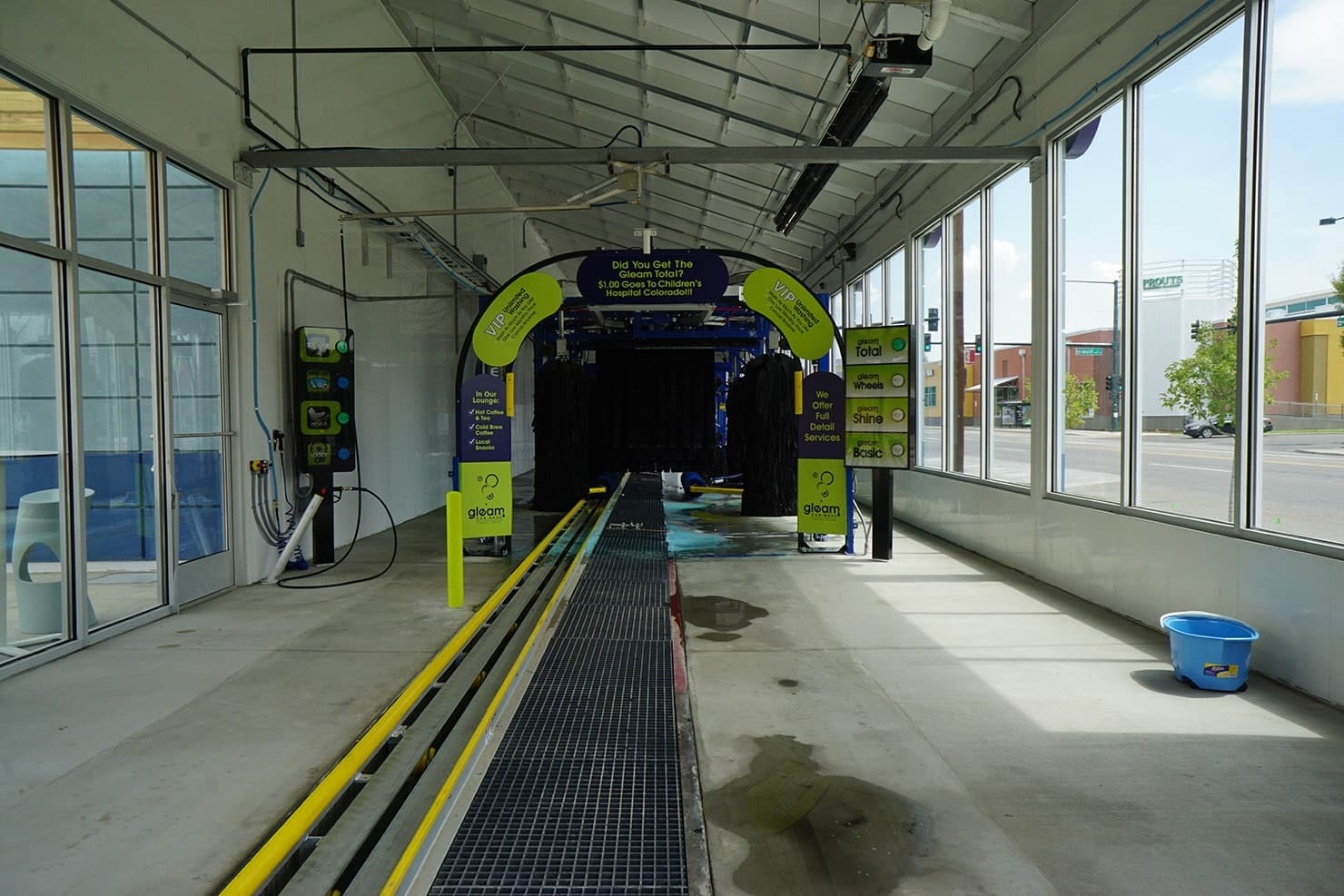
A car wash roof fails from the inside out. While most commercial buildings worry about what rain and sun do to the top of the membrane, a wash facility fights a second front underneath: warm, saturated air rising off the tunnel hour after hour, carrying detergent, brightener, and drying-agent vapor straight into the underside of the deck. We build roofs for Omaha wash operators that treat that interior load as the primary threat, not an afterthought.
Why a Wash Tunnel Eats Roofs From Below
Step inside an operating tunnel on a January morning and you can see the problem hanging in the air. The wash bay runs warm and wet against single-digit outside temperatures, and that humid air drives upward until it hits the cold underside of the steel deck. There it condenses. Day after day, that condensation sits on the topside of the deck, on the fastener heads, and on the bottom of the insulation, and it does what salt water does to a car frame. Steel decks corrode. Plates rust through. Screw threads lose their grip on metal that has been weeping for years. By the time a stain shows up on the ceiling tile inside the lobby, the damage has usually been advancing unseen for a long stretch.
The chemistry makes it worse. Tire-shine and wheel-cleaner aerosols, alkaline presoaks, and the wax and sealant top-coats all become airborne in the tunnel and ride that rising vapor. Those compounds attack adhesives and plasticizers in ways plain water never does. This is why a membrane that performs fine on a dry warehouse two blocks away can break down early over a wash line. We design for the vapor and the chemistry together, because on a car wash they arrive together.
The Membrane We Trust Over a Wash Line
For the tunnel and equipment bays we lean on PVC, typically a 60-mil reinforced sheet, fully adhered. PVC holds up to the alkaline and oily chemistry of a wash floor far better than the alternatives, and hot-air welded PVC seams give a monolithic surface with no adhesive bond line to chemically degrade. Fully adhering it kills the flutter that tunnel air pressure causes under a mechanically fastened sheet, and it keeps us from driving a field of fasteners down into a deck that is already fighting condensation. Just as important as the sheet on top is the layer underneath: a properly detailed air and vapor barrier that stops humid tunnel air from ever reaching the cold deck. Get the vapor control right and the corrosion problem largely disappears. Skip it and no top membrane will save the structure.
For the dry parts of the property — the cashier and office areas, the equipment mezzanine, the customer waiting space — we don't over-build. A mechanically attached TPO or PVC system is appropriate there, and we draw the line on the plan between the aggressive wash zone and the conventional roof so each gets what it actually needs.
Penetrations and Exhaust Are Where Wash Roofs Leak
A tunnel roof is crowded. Blower stacks, the tunnel exhaust fans that pull steam out of the bay, hot-water heater flues, gas lines feeding the boiler, and conduit for the wash controls all break the plane. Every one of those is a potential leak and a potential corrosion path, because the air escaping around a hot exhaust curb is the same chemical-laden air doing damage everywhere else. We flash each penetration as its own detailed item with welded PVC boots and target-patches, oversize the curbs on the steam exhaust so the flashing isn't fighting constant heat and movement, and seal the curb-to-deck connection from below where we can reach it. Pitch pans full of dried-out caulk are not a detail we leave in place on a building that runs this wet.
Vacuum Canopies, Pay Stations, and Exit Awnings
Express washes live or die on the vacuum lot, and the canopies over the vac stalls and pay lanes are their own roofing scope. These are usually low-slope metal or membrane decks tied back to the main building, and the joint where the canopy meets the building wall is the single most common chronic leak we find on Omaha express sites. Add tire-dressing overspray drifting up onto the canopy underside and ponding at undersized internal drains, and a canopy that looks fine from the lot can be quietly rotting at the connection. We inspect canopy-to-wall flashing, drain and downspout connections, and seam condition as a standard part of the assessment and price them as discrete items rather than burying them in a lump sum.
Working on a Wash That Can't Close
A wash near 144th and Maple, along the Saddle Creek and Dodge corridors, or out by the rooftops in Papillion and La Vista isn't going to shut for a week so we can re-roof it — every closed day is gone-for-good revenue, and in Omaha the good wash weather is short. We sequence around that. Tunnel-roof work that requires opening the bay gets done in the early-morning or after-close window when the equipment is down and the floor is clear. Office, mezzanine, and canopy work proceeds during operating hours with the crew and staging positioned to keep cars and the vacuum lot moving. Every section gets dried in before we leave for the day, because the last thing a wash owner needs is our open seam meeting the next thunderstorm rolling across Douglas County.
What We Look At First
- Topside-of-deck and fastener condition over the tunnel — the corrosion tell that surface leaks hide
- Whether a functioning air and vapor barrier exists below the membrane, and where it has failed
- Membrane chemistry against the actual chemical menu the wash runs, including tire and wheel products
- Steam-exhaust and blower-stack curbs, flues, and every conduit penetration through the tunnel roof
- Canopy-to-building flashing and drain connections on vac stalls, pay lanes, and exit awnings
- Internal and scupper drainage over the equipment bays, where ponding is common and quietly destructive
Car Wash Roofing Questions
Almost always because the original job treated it like an ordinary commercial roof and never addressed the interior vapor load. Warm, chemical-laden air off the wash line condenses on the cold deck underside and corrodes the structure and fasteners from below — a top membrane alone can't stop that. The fix is a properly detailed air and vapor barrier under a chemical-resistant sheet, so the humid tunnel air never reaches the cold steel.
PVC stands up to the alkaline presoaks, oily tire products, and wax compounds in a wash environment better than TPO or EPDM, and its heat-welded seams have no adhesive bond line for those chemicals to break down. We fully adhere it so tunnel air pressure can't flutter the sheet and so we're not driving a fastener field into a deck that's already dealing with condensation. The dry parts of the building don't need PVC, and we spec those conventionally.
It can. Standard single-ply warranties often exclude chemical attack, so before we finalize a tunnel spec we match your actual chemical menu against the manufacturer's chemical-resistance data and confirm the system and warranty cover those conditions. Where a manufacturer offers a chemical-exposure or wash-specific warranty, we pursue it rather than leaving you with coverage that has a hole in it exactly where your roof works hardest.
Yes, with sequencing. We do the tunnel-roof work that requires opening the bay in the early-morning or after-close window when equipment is down, and we run office, mezzanine, and canopy work during business hours with staging that keeps the lanes and vacuum lot clear. Every area is dried in before we leave each day so an open section never meets an overnight storm.
They do, and on express sites they're often where the real leaks are. We inspect the canopy-to-building flashing, the drain and downspout connections, and the seams on vac-stall covers, pay lanes, and exit awnings, then price any repair or replacement as its own line item. The connection back to the main building wall is the spot we check hardest, because that joint fails quietly.
Ready to talk through a roof?
Tell us about the building and the roof problem. We'll document it and put a plan in writing — with an honest repair-vs-replace recommendation and no upsell pressure.